
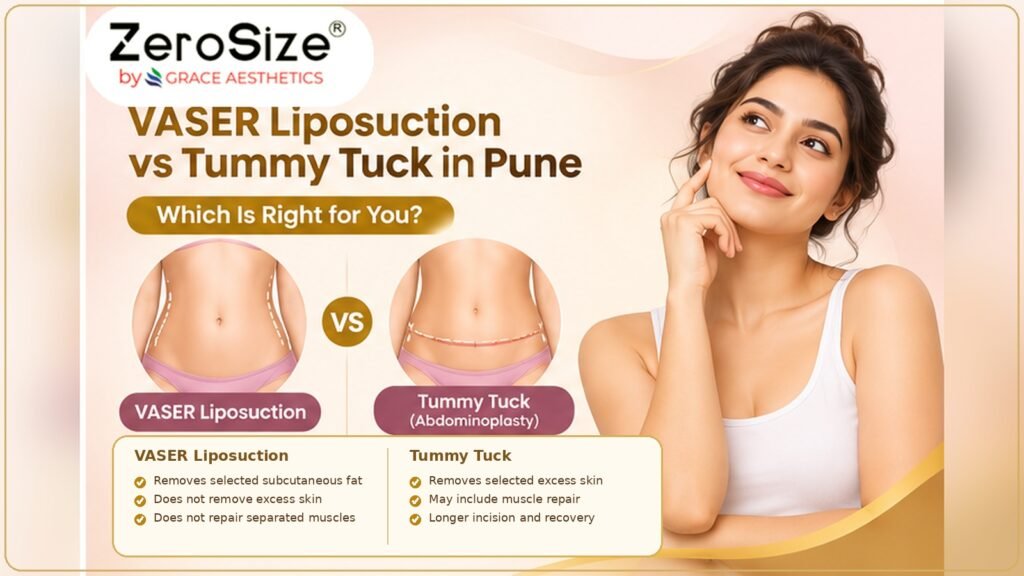
VASER liposuction vs tummy tuck in Pune is a common comparison for people concerned about abdominal fullness, waist contour or changes after pregnancy or weight loss. The procedures are not interchangeable. Liposuction removes selected deposits of subcutaneous fat beneath the skin. A tummy tuck (abdominoplasty) removes excess abdominal skin and may include repair of separated abdominal muscles when clinically indicated. VASER is an ultrasound-assisted liposuction technique; it does not turn liposuction into a skin-removal or muscle-repair operation.
For patients searching Liposuction vs Tummy Tuck in Pune, the right question is not which procedure is “better” in general, but which anatomical concern needs to be addressed and whether surgery is appropriate for the individual. This guide compares the procedures, candidacy considerations, scars, recovery, risks and cost factors. At ZeroSize® by Grace Aesthetics, Pune, patients can discuss their concerns with Dr. Sheetal Londhe, a Board-certified Female Plastic Surgeon in India, holding DNB (Plastic Surgery) from the National Board of Examinations in Medical Sciences (NBEMS), with FACS (USA) and NMC registration. An examination is necessary before a treatment recommendation can be made.
Medical review status: Medically reviewed by Dr. Sheetal Londhe · Plastic Surgeon, Pune · NMC Reg. No. 2005042532 · Maharashtra Medical Council Reg. No. 2005/04/2532 · Last reviewed: 18 NOVEMBER 2026
Clinic: ZeroSize® by Grace Aesthetics, Pune
Liposuction vs Tummy Tuck: quick answer
Liposuction may be considered when the main concern is a localised deposit of subcutaneous fat and the skin is expected to adapt reasonably after fat removal. A tummy tuck may be considered when there is significant excess abdominal skin, a hanging fold or abdominal muscle separation that needs assessment. Some patients have a combination of fat and skin excess, but that does not mean both operations are automatically needed or should be combined.
VASER is one ultrasound-assisted method of liposuction. It may be discussed for selected fat-removal plans, but it does not remove significant loose skin or repair diastasis recti. The choice should follow a clinical examination, medical history, discussion of alternatives and review of risks and recovery requirements.
Liposuction vs Tummy Tuck: anatomical differences
Abdominal fullness can come from more than one tissue layer. Subcutaneous fat sits beneath the skin and above the abdominal wall. Visceral fat is deeper inside the abdominal cavity around internal organs. The skin can become loose after pregnancy, weight change or ageing. The abdominal muscles can separate, producing a change in the abdominal wall. A hernia or other medical issue may also contribute to a bulge and needs appropriate assessment.
Liposuction is designed to remove selected subcutaneous fat. A tummy tuck is an operation that removes selected excess skin and may include muscle repair when indicated. Neither is a treatment for visceral fat or general obesity. Selecting the procedure by name before understanding the cause of fullness risks mismatching the operation to the concern. An assessment should distinguish the different structures and explain what each operation can and cannot change.
What is liposuction?
Liposuction is a surgical procedure in which a cannula is introduced through small access incisions to remove selected subcutaneous fat. The surgeon plans the treatment areas and the amount of fat removal according to the patient’s anatomy, skin quality and safety considerations. Liposuction is a body-contouring operation, not a weight-loss treatment. It does not remove internal visceral fat, excise significant excess skin or repair separated abdominal muscles.
Different liposuction methods may be used to assist fat removal. These include suction-assisted, power-assisted and ultrasound-assisted techniques. VASER is a form of ultrasound-assisted liposuction in which energy is delivered through a probe beneath the skin before fat is aspirated. The device does not determine whether the patient is suitable, and it should not be described as universally superior to other methods. Technique selection depends on the tissue, treatment plan, surgeon’s training and evidence.
What is VASER liposuction?
VASER is a third-generation ultrasound-assisted liposuction platform. It uses ultrasound energy as an adjunct to fat removal. It remains a surgical procedure performed through access incisions and with an appropriate anaesthesia and facility plan. It is not an external non-surgical treatment and it is not a substitute for abdominoplasty when skin excision or abdominal wall repair is needed.
A 2026 scoping review describes possible technical uses of VASER in fibrous fat and advanced three-dimensional contouring, but notes that comparative evidence is limited and does not establish universal superiority over conventional liposuction. The review also notes that the technique should not be relied upon to correct clinically important excess skin. Patients should ask why VASER is being proposed in their case, what alternatives exist and what risks apply, including thermal injury.
What is a tummy tuck (abdominoplasty)?
A tummy tuck is a surgical procedure designed to remove selected excess abdominal skin. Depending on the patient’s anatomy and operation, it may also involve tightening or repair of separated abdominal muscles. The incision is usually longer than the small access incisions used for liposuction, and the operation has a different scar, recovery and risk profile. The location and extent of skin removal depend on the clinical plan.
Abdominoplasty is not a substitute for weight loss and is not intended to remove visceral fat. It is considered when skin excess or abdominal wall changes are important to the patient’s concern. Some patients may also have localised fat, and liposuction may be discussed as a component of an individual plan. Combining procedures requires a separate assessment of operative extent, anaesthesia, health and recovery demands. It should not be assumed to be appropriate for everyone.
Liposuction vs tummy tuck: comparison table
The table below provides a broad comparison. It is not a substitute for a medical examination, and the exact procedure can vary depending on the patient’s anatomy and the operation proposed.
Liposuction vs Tummy Tuck: which addresses your concern?
The Liposuction vs Tummy Tuck decision should follow an assessment of the abdominal skin, fat layer and abdominal wall. When a patient has a localised pinchable fat deposit beneath skin that has reasonable elasticity, liposuction may be considered. If the main concern is a hanging lower abdominal skin fold, loose skin with stretch marks or a weakened abdominal wall, a tummy tuck assessment may be more relevant. A patient who has both fat and skin excess may need a discussion of both components and the safety of any combined plan.
Some abdominal shapes are influenced mainly by visceral fat or general weight gain. Neither liposuction nor tummy tuck removes visceral fat or treats obesity. When a bulge is caused by a hernia or another abdominal wall condition, that issue needs medical assessment. It is important not to treat all abdominal fullness as cosmetic fat because the underlying cause determines which options are appropriate.
Who may be suitable for liposuction vs tummy tuck?
A person may be assessed for liposuction when there is a localised subcutaneous fat deposit, reasonably stable weight, suitable skin quality and general health that allows elective surgery. The patient should understand that fat removal changes selected contours and does not guarantee a flat abdomen, particular waist measurement or specific clothing size. The surgeon also considers the total area and volume of treatment, anaesthesia and recovery.
Health conditions, current medicines, allergies, smoking or nicotine use, clotting history, prior surgery, scars and expectations are important. If the person has significant loose skin or muscle separation, liposuction alone may not address the concern. A surgeon may recommend a different procedure, a medical assessment, weight-management support or no surgery depending on findings.
Who may be considered for a tummy tuck?
For someone comparing Liposuction vs Tummy Tuck, an examination helps determine whether skin removal or muscle repair needs to be discussed. A tummy tuck may be discussed for an adult with excess abdominal skin, a persistent lower abdominal fold or abdominal wall concerns such as diastasis recti, after a suitable medical assessment. The patient should understand the longer incision, scar, recovery demands and possible complications. Weight stability and future pregnancy plans may be relevant when discussing timing, but the decision is individual.
The surgeon assesses the extent of skin excess, stretch marks, scars, abdominal wall, possible hernia, general health, medicines and the patient’s ability to recover safely. A tummy tuck is a more extensive operation than limited-area liposuction and should not be considered solely because someone wants a smaller abdomen. The purpose, limitations and alternatives should be explained before consent.
After pregnancy or C-section: which operation is assessed?
Pregnancy can affect the abdomen in several ways. Some people have localised subcutaneous fat, while others have loose skin, stretch marks or separation of abdominal muscles. A C-section scar may influence the skin and tissue assessment. Liposuction addresses selected fat only. A tummy tuck may be considered when excess skin or muscle separation is a central concern, but it is not appropriate for every postpartum patient.
Timing should be discussed after childbirth, including recovery from delivery, breastfeeding where relevant, weight stability, future pregnancy plans and overall health. A subsequent pregnancy can change the abdominal skin and wall after surgery, so family plans may be part of the decision. There is no single online timeline that suits everyone. The patient and treating team should discuss timing, risks and alternative options.
After major weight loss: liposuction or tummy tuck?
After significant weight loss, some people have remaining localised fat deposits, while others have loose skin that does not retract to the new body volume. These are different concerns. Liposuction may be assessed for selected residual fat when skin quality is suitable, but removing more fat beneath loose skin can make skin excess more obvious. A tummy tuck or another skin-removal procedure may be discussed when hanging skin is the main issue.
Patients after major weight change may need an assessment of nutrition, weight stability, medical conditions, scars and skin quality. The procedure should be planned around health and recovery, not just the amount of skin or fat visible. In some cases, staged procedures may be considered. The surgeon should explain which body areas can be addressed, which would remain and what scars and recovery requirements are involved.
Diastasis recti: why fat removal is not muscle repair
Diastasis recti refers to separation or widening of the connective tissue between the abdominal muscles. It can occur after pregnancy or with changes in abdominal pressure and body structure. A person with diastasis may notice abdominal doming or a change in the abdominal wall. It is not the same as a layer of subcutaneous fat, and liposuction does not bring separated muscles back together.
A tummy tuck may include repair of the abdominal wall in selected patients, depending on examination and surgical judgement. Not every case of diastasis requires surgery, and a medical assessment may consider symptoms, functional concerns and alternative management. If a hernia is suspected, that requires a separate evaluation. Patients should avoid assuming that abdominal liposuction will correct a muscle-related bulge.
Liposuction vs Tummy Tuck: scars and incisions
Liposuction usually involves small access incisions placed according to the treatment area and surgical plan. These can leave small scars, and their visibility varies with healing, skin type, location and aftercare. A tummy tuck involves a longer incision across the lower abdomen, with the scar placement and length depending on the operation and the amount of skin to be removed. The navel may also be repositioned in some forms of abdominoplasty.
Neither operation is scar-free. Patients should ask where incisions are likely to be placed, how wounds are managed, what scar care may be recommended and what factors can affect healing. Smoking or nicotine use, infection, tension, medical conditions and individual scar behaviour can affect the final appearance. The surgeon should explain the trade-off between the procedure’s purpose and the scar it requires.
Liposuction vs Tummy Tuck: recovery and activity
Recovery varies according to the extent of treatment and the individual. After liposuction, patients may experience swelling, bruising, soreness, temporary changes in sensation and drainage from small access sites. Compression may be advised. The return to work and exercise depends on the number of areas treated, job demands, anaesthesia and healing.
Recovery after tummy tuck may involve a longer incision, more restricted movement and specific instructions about posture, wound care and activity. If muscle repair is included, the recovery requirements can differ from skin removal alone. Patients may need help at home during the early period. No generic timeline should replace individual instructions. The surgical team should provide a clear plan for garments, walking, driving, lifting, work, exercise and follow-up.
Risks and possible complications
Both operations carry risks, but the exact risk profile differs. Liposuction risks may include bleeding, infection, seroma, contour irregularity, asymmetry, sensory changes, scarring, delayed healing, blood clots, pulmonary complications, injury to deeper structures and anaesthesia-related complications. Ultrasound-assisted methods such as VASER also carry a risk of thermal injury or burns.
Tummy tuck risks may include bleeding, infection, fluid collection, wound-healing problems, scar concerns, skin or tissue loss, altered sensation, asymmetry, blood clots, anaesthesia-related complications and the possibility of revision or further treatment. Combining procedures can change operative duration and recovery demands. Liposuction vs Tummy Tuck counselling should compare procedure-specific risks, scars, recovery and facility arrangements. Patients should ask which risks are relevant to their own health, how complications are prevented and managed, and what facility and follow-up arrangements are available.
Liposuction vs Tummy Tuck cost in Pune
Liposuction cost depends on the areas treated, technique, operative complexity, anaesthesia, hospital and operating-room charges, investigations, garments, medicines and follow-up. VASER-related equipment and the scope of a multi-area plan can influence the estimate. A tummy tuck estimate may also reflect skin excision, possible muscle repair, operating time, hospital arrangements and post-operative care. The two estimates should not be compared as if they were the same procedure.
Patients should request a written, itemised estimate that matches the proposed treatment plan. Check which areas and procedures are included, whether surgeon and anaesthesia fees are separate, what hospital or room charges apply, and what may be charged later. For local information, see VASER Liposuction Cost in Pune and Tummy Tuck Cost in Pune. A personalised estimate follows assessment.
Can liposuction and tummy tuck be combined?
In selected patients, liposuction may be considered alongside abdominoplasty to address different anatomical components. The decision depends on the patient’s health, skin and fat distribution, abdominal wall, operative duration, anaesthesia and facility arrangements. Combining procedures is not automatically safer, faster or appropriate. A surgeon may recommend a limited plan or staged operations when that better fits the patient’s medical circumstances.
Patients should ask which part of the concern each procedure is intended to address, what the combined operation adds to recovery and risk, and whether an alternative sequence would be more appropriate. The written consent should state which procedures are planned and why. The estimate should match that plan. There should be enough time to consider the information and make an informed decision.
How consultation helps decide Liposuction vs Tummy Tuck
A consultation begins with the patient’s concerns, goals and medical history. The surgeon may ask about pregnancy, weight change, previous operations, medicines, allergies, smoking, clotting history and previous anaesthesia. The physical examination assesses the skin, subcutaneous fat, abdominal wall, muscle separation, scars and any possible hernia. The surgeon may examine the abdomen in different positions because posture and muscle activation can change the visible contour.
Following assessment, the surgeon should explain whether liposuction, VASER-assisted liposuction, tummy tuck, a combination, a staged plan or no surgery is more appropriate. The discussion should include limitations, scars, recovery, risks, facility and anaesthesia arrangements and an estimate. A patient should not feel pressured to select a procedure during the first visit. Questions should be welcomed, and alternatives should be explained in plain language.
Quick comparison: liposuction and tummy tuck
| Question | Liposuction / VASER | Tummy tuck |
|---|---|---|
| Main target | Selected subcutaneous fat | Excess abdominal skin; may include muscle repair |
| Fat removal | Yes, selected localised fat | May be combined with limited liposuction in selected plans |
| Skin removal | No significant skin excision | Yes, selected excess skin is removed |
| Muscle repair | Does not repair diastasis recti | May include abdominal muscle repair when indicated |
| Incisions | Small access incisions | Usually a longer lower abdominal incision |
| Scar and recovery | Small scars; extent-dependent recovery | Longer scar and typically more involved recovery |
| Main assessment | Fat distribution, skin quality, health | Skin excess, abdominal wall, scars and health |
Short answers: VASER liposuction vs tummy tuck
Is VASER liposuction the same as a tummy tuck?
No. VASER is an ultrasound-assisted liposuction technique used to remove selected fat. A tummy tuck removes excess abdominal skin and may include repair of separated muscles.
Which is better for belly fat: liposuction or tummy tuck?
It depends on whether the fullness is caused by subcutaneous fat, excess skin, muscle separation, visceral fat or a combination. An examination is needed.
Can VASER remove loose abdominal skin?
No. VASER should not be relied upon to remove significant loose skin. A skin-removal procedure may be discussed if excess skin is the main concern.
Can liposuction fix diastasis recti?
No. Liposuction removes fat and does not repair separated abdominal muscles. A tummy tuck may include muscle repair in selected patients.
Is tummy tuck a weight-loss operation?
No. Abdominoplasty removes selected excess skin and may address muscle separation. It is not a treatment for obesity or visceral fat.
Can liposuction and tummy tuck be done together?
They may be combined in selected patients, but the decision depends on health, operative extent, anaesthesia and recovery considerations.
Does a tummy tuck leave a scar?
Yes. It usually involves a longer lower-abdominal incision. The location and length depend on the amount of skin to be removed and the surgical plan.
Does VASER leave scars?
Liposuction uses small access incisions that can leave small scars. Scar visibility varies and no surgery is scar-free.
How do I know which procedure I need?
A plastic surgeon assesses fat distribution, skin quality, abdominal wall, medical history and expectations before discussing options.
Where can I compare options in Pune?
You can enquire at ZeroSize® by Grace Aesthetics, Viman Nagar, Pune, about an individual consultation with Dr. Sheetal Londhe.
Long-answer questions about choosing between liposuction and tummy tuck
How do I know whether my abdomen needs fat removal or skin removal?
The distinction requires a clinical examination. The surgeon reviews the history of weight change, pregnancy and previous surgery, then assesses the thickness of the subcutaneous fat layer, skin elasticity, stretch marks, scars and abdominal wall. A localised fat deposit under skin with suitable elasticity may lead to a liposuction discussion. A hanging fold or significant loose skin may make abdominoplasty more relevant. Muscle separation or a hernia requires separate assessment. Some patients have more than one factor, so the plan may involve comparing procedures rather than assuming one operation is enough.
Can VASER liposuction give the same result as a tummy tuck without the long scar?
No. The procedures address different anatomical structures. VASER-assisted liposuction removes selected fat through small access incisions. A tummy tuck removes excess skin through a longer incision and may include abdominal muscle repair. If the main issue is skin excess or muscle separation, liposuction cannot reproduce the effect of skin excision or muscle repair. The choice should reflect the anatomy and the trade-off between treatment goals, scars, recovery and risks.
After pregnancy, should I choose VASER liposuction or tummy tuck?
Pregnancy can lead to localised fat, loose skin, stretch marks and abdominal muscle separation in different combinations. VASER may be discussed when selected subcutaneous fat is the main concern and the skin is suitable. A tummy tuck may be assessed when excess skin or muscle separation is important. The timing of elective surgery should also consider recovery after childbirth, breastfeeding where relevant, weight stability, future pregnancy plans and general health. An in-person assessment is needed; there is no single rule for everyone.
What are the most important differences in recovery?
Liposuction recovery can include swelling, bruising, soreness, altered sensation and compression garment use. Recovery depends on how many regions are treated and the extent of the operation. Tummy tuck recovery may involve a longer incision, more wound care and specific restrictions on stretching or lifting, particularly if muscle repair is performed. Combining procedures may increase the demands further. The surgeon should give individual instructions for walking, garment use, bathing, work, driving, exercise, lifting and follow-up.
Why is a physical examination important before choosing a procedure?
A photograph or online form cannot reliably assess tissue thickness, skin recoil, muscle separation, hernia, scars, abdominal wall function or the full medical history. The surgeon needs to identify what causes the abdominal contour concern and whether there are health factors that change the risk of surgery. Examination also helps define what each operation could realistically address. This reduces the risk of choosing a procedure that targets the wrong anatomical problem.
How should I compare liposuction and tummy tuck quotations?
First confirm that the quotations refer to the same type and extent of treatment. A liposuction quote may cover only selected fat removal, while a tummy tuck quote includes skin excision and may include muscle repair. Compare the named procedures, areas, surgeon and anaesthesia fees, hospital and room charges, investigations, garments, medicines, follow-up and exclusions. A lower headline price does not necessarily describe the same treatment or services. Ask for an itemised estimate that follows the clinical plan.
Pune consultation: understanding treatment options
People searching for VASER liposuction versus tummy tuck in Pune may use terms such as liposuction or abdominoplasty, belly fat removal, loose abdominal skin surgery, post-pregnancy tummy tuck or diastasis recti repair. The search phrase does not tell the surgeon which procedure is appropriate. The assessment should identify whether the concern relates to subcutaneous fat, excess skin, abdominal wall separation or a combination.
ZeroSize® by Grace Aesthetics is located at Town Square, above Dorabjee’s, Viman Nagar, Pune. Patients may enquire from Kharadi, Kalyani Nagar, Koregaon Park, Hadapsar, Baner, Balewadi, Kothrud, Deccan, Pune Camp, Kondhwa, Undri, Pimpri-Chinchwad, Ravet and Wakad. The locality references are for patients considering travel to the Viman Nagar consultation location; they are not separate clinic branches.
Patients travelling across Pune should discuss appointment timing, transport, the need for an accompanying adult after anaesthesia and follow-up arrangements before surgery. The proposed hospital and operating facility should be confirmed separately as part of the treatment plan.
Related ZeroSize® guides
- Liposuction in Pune: Complete Guide to Procedure, Suitability, Recovery and Risks.
- 360° VASER Liposuction in Pune: Complete Guide to Body Contouring.
- VASER Liposuction Cost in Pune.
- Tummy Tuck in Pune: Complete Guide to Abdominoplasty.
- Tummy Tuck Cost in Pune.
- Tummy Tuck and Breast Lift in Pune: Combined Surgery Explained.
Related VASER and body-contouring guides
- Best Areas for VASER Liposuction in Pune: Abdomen, Waist and Thighs
- Abdominal Liposuction in Pune: Treatment for Stubborn Belly Fat
- Waist and Love Handle Liposuction in Pune: Body Contouring Guide
Related ZeroSize® Instagram Reels
These short videos provide additional educational context. They do not replace an individual consultation or determine whether a procedure is suitable.
- Liposuction versus tummy tuck: ZeroSize® Reel explaining the difference between liposuction and tummy tuck.
- Abdominal changes after pregnancy: ZeroSize® Reel discussing liposuction for a post-pregnancy abdomen.
Book an Appointment with Dr. Sheetal Londhe
Have questions about your treatment options? Request a consultation at ZeroSize® by Grace Aesthetics, Viman Nagar, Pune, to discuss your concerns, clinical assessment, alternatives, limitations, risks and recovery requirements. A consultation does not mean that surgery will necessarily be recommended.
Prefer to call? +91 77690 07781
More VASER Liposuction Patient Guides
- Who Is Eligible for VASER Liposuction in Pune? Suitability, Assessment and Health Considerations.
- VASER Liposuction Recovery in Pune: Timeline, Compression Garments and Aftercare.
Medical references and further reading
- American Society of Plastic Surgeons (ASPS): Liposuction overview.
- ASPS: Tummy tuck (abdominoplasty) overview.
- ASPS: Liposuction risks and safety.
- NHS: Liposuction – procedure, recovery and risks.
- Third Generation Ultrasound-Assisted Liposuction: A Scoping Review and Evidence Map, Aesthetic Surgery Journal Open Forum, 31 October 2026.
Consultation at ZeroSize® by Grace Aesthetics, Pune
Patients who are comparing Liposuction vs Tummy Tuck in Pune and tummy tuck may enquire about an individual assessment with Dr. Sheetal Londhe, Board-certified Female Plastic Surgeon in India (DNB, Plastic Surgery – NBEMS; FACS, USA; NMC-registered). The consultation can help identify the anatomical concern, discuss alternatives and explain risks, scars, recovery and estimate requirements. It does not mean that a particular procedure will necessarily be recommended.
ZeroSize® by Grace Aesthetics
Town Square, above Dorabjee’s, Viman Nagar, Pune, Maharashtra, India.
Appointments: +91 77690 07781
Website: zerosize.in
Medical disclaimer
This article is for general educational purposes only. It does not provide a diagnosis, personal medical advice or a recommendation to undergo surgery. Suitability, procedure choice, anaesthesia, treatment areas and aftercare must be determined by the treating medical team after an appropriate assessment. Individual anatomy, recovery and risks vary. All surgery carries risks, which should be discussed before informed consent.