
Extended Tummy Tuck Pune (extended abdominoplasty surgery in Pune) is a surgical option that may be considered when excess skin and tissue extend beyond the central abdomen toward the flanks or sides of the waist. The incision and skin removal may extend farther than in a standard abdominoplasty. The appropriate approach depends on anatomy, prior surgery, weight history, skin quality, medical health and the goals discussed during consultation. It is not a weight-loss procedure, and no technique can guarantee a particular contour or outcome.
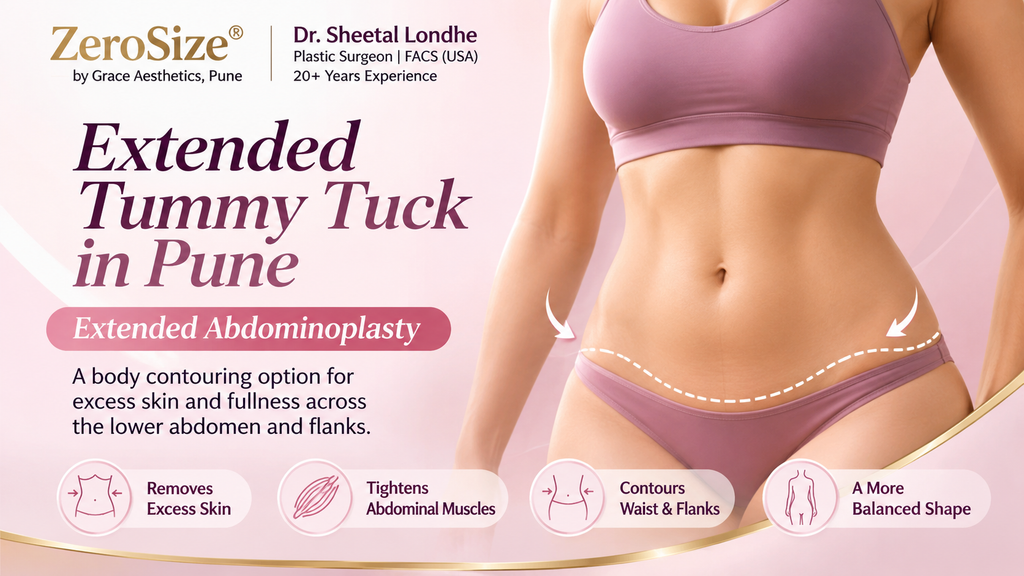
This guide explains what an extended tummy tuck involves, how it differs from a full or mini tummy tuck, who may be assessed for it, why it may be discussed after substantial weight loss or pregnancy, what scars and recovery can involve, risks, preparation, cost factors and questions to ask. Patients in Pune can discuss their concerns and surgical options with Dr. Sheetal Londhe at ZeroSize® by Grace Aesthetics, Viman Nagar, Pune.
Medical review status: Medically reviewed by Dr. Sheetal Londhe · Plastic Surgeon, Pune · NMC Reg. No. 2005042532 · Maharashtra Medical Council Reg. No. 2005/04/2532 · Last reviewed: 22 NOVEMBER 2026
Clinic: ZeroSize® by Grace Aesthetics, Viman Nagar, Pune
Quick answer: What is an Extended Tummy Tuck Pune procedure?
An extended tummy tuck is a form of abdominoplasty in which skin and tissue removal may extend laterally beyond the lower abdomen toward the flanks. It may be considered when a patient has skin excess or folds that continue around the sides of the torso, rather than being limited to the central abdomen. The operation may also include abdominal wall assessment and repair when clinically indicated, but muscle repair is not automatically required for every patient.
The extended incision may help address a broader pattern of skin excess, but it also means a longer scar and a more extensive operation than some limited approaches. The surgeon must assess skin distribution, tissue blood supply, previous scars, medical risks, the amount of planned tissue removal, and the patient’s ability to recover. An extended tummy tuck is not necessarily the best choice simply because it removes more skin; the operation must match the patient’s anatomy and goals.
What is extended abdominoplasty?
Abdominoplasty, commonly called a tummy tuck, is surgery that removes selected excess abdominal skin and may address abdominal wall laxity or separated rectus muscles in suitable patients. An extended abdominoplasty uses a longer incision and may remove skin and tissue that extend toward the flanks. The extent and direction of the incision vary with anatomy and the surgical plan. The surgeon considers where skin folds, how tissue moves, the location of existing scars, and what can be removed safely.
Some patients have a lower abdominal skin fold with excess extending across the sides of the waist. Others have skin laxity after substantial weight change that involves a wider area. An extended approach may be discussed for these patterns, but examination is needed to determine whether an extended tummy tuck, standard abdominoplasty, a different body-contouring procedure or staged treatment is appropriate.
The operation generally involves planning the incision, removing a segment of excess skin and tissue, repositioning or managing the umbilicus when required by the technique, and closing the incision. Muscle or fascia repair may be considered if abdominal wall separation is assessed and the surgeon believes repair is indicated. Liposuction may be considered in selected areas, but it is not a routine addition for everyone and must be planned with attention to tissue blood supply and overall operative risk.
Why is an extended tummy tuck different from a standard tummy tuck?
A standard full abdominoplasty primarily addresses excess skin in the central abdomen and lower abdominal region, with incision design tailored to the patient. An extended abdominoplasty may lengthen the incision toward the sides to address additional skin excess at the flanks. The difference is not simply a larger version of the same operation; the pattern of skin excess, tissue mobility, scar placement, closure tension and recovery considerations can change.
Patients should understand that an extended approach can result in a longer scar. A longer incision may be necessary to address the distribution of skin excess, but scar length, healing, contour and symmetry vary. The surgeon should show and explain the likely scar position, how it may be concealed by clothing, and the possibility of scar widening, irregularity or revision.
In some patients, a standard abdominoplasty may be sufficient. In others, excess skin continues beyond the abdomen and a limited operation may leave folds at the sides. The decision is based on examination and shared decision-making, not on a standard label or a photograph alone.
Extended tummy tuck vs full tummy tuck vs mini tummy tuck
Mini tummy tuck: may be considered for selected patients with limited lower abdominal skin excess and appropriate anatomy. It generally involves a more limited skin excision and does not address all the concerns that a full abdominoplasty may address. It is not suitable for every lower abdominal fold.
Full tummy tuck: may address a broader area of central abdominal skin excess, and may include umbilical repositioning and selected abdominal wall repair. The incision and tissue movement depend on the individual plan.
Extended tummy tuck: may be considered when skin excess extends beyond the central abdomen toward the flanks. The incision may be longer to address the broader distribution. The operation may be more extensive, and the scar and recovery considerations should be discussed in detail.
These names describe broad approaches, not fixed templates. The surgeon may recommend a different incision pattern or staged procedure. Patients should ask what each option can address, what it will not address, how scars differ, and why one approach is being recommended.
Who may be assessed for extended abdominoplasty?
Adults with excess skin extending across the abdomen and toward the flanks may be assessed for extended abdominoplasty if their health and circumstances support elective surgery. Common reasons for consultation include persistent skin folds after substantial weight loss, abdominal skin changes after pregnancy, or skin excess that affects clothing fit, comfort or personal goals. The operation is not indicated by a single weight, BMI, waist measurement or photograph.
Assessment includes skin quality and distribution, fat beneath the skin, abdominal wall condition, possible diastasis recti or hernia, prior incisions, weight stability, medical history, medications, nicotine exposure, nutritional status, expectations and recovery support. The surgeon may recommend health optimisation, further investigations, a different operation or postponement if risks need to be addressed.
Patients should ideally have a weight that is reasonably stable and understand that future weight change can alter the contour. Pregnancy after surgery may affect abdominal skin and the abdominal wall; patients planning future pregnancy should discuss timing before considering an operation. Surgery does not prevent pregnancy, and pregnancy-related changes may influence later results.
Extended tummy tuck after major weight loss
After substantial weight loss, skin may not retract to the degree a person hopes. Skin folds can extend across the abdomen and toward the flanks. Extended abdominoplasty may be discussed when excess skin is distributed more broadly than the central abdomen. The assessment may also consider folds at the back, hips, thighs, arms or other areas, but these may require separate procedures and are not automatically included.
Weight stability, nutritional status, medical conditions, previous bariatric procedures, scars and the extent of skin excess are relevant. Patients who have undergone bariatric surgery may need review of nutritional deficiencies or other medical issues before elective body-contouring surgery. The surgeon may coordinate with the patient’s physician or bariatric team when appropriate.
An extended tummy tuck does not treat obesity, visceral fat or metabolic conditions, and it is not a substitute for ongoing weight-management care. It removes selected excess skin and tissue according to the operative plan. Patients should understand the limits of contouring and the possibility that additional staged procedures may be considered, or may not be appropriate.
Extended tummy tuck after pregnancy or C-section
Pregnancy may contribute to skin laxity, stretch marks, changes in fat distribution and abdominal wall separation. A previous Caesarean section is part of the surgical history and may affect incision planning or tissue assessment, but it does not by itself determine candidacy. Timing after pregnancy is individual and may consider recovery from childbirth, breastfeeding, weight stability, future pregnancy plans, medical health and practical support at home.
Patients should discuss the timing of surgery and whether future pregnancy is planned. The surgeon may recommend waiting until postpartum recovery and weight stability are established. A tummy tuck does not treat all causes of abdominal prominence; the examination should distinguish skin, subcutaneous fat, abdominal wall changes, visceral fat and other medical conditions.
What concerns may an extended tummy tuck address?
Depending on anatomy and the operation, extended abdominoplasty may address selected excess skin across the lower abdomen and toward the sides. It may improve the management of skin folds that extend laterally, but it cannot guarantee a particular waistline, symmetry, smoothness or result. Skin quality, tissue thickness, healing, future weight change and scar characteristics all influence the outcome.
The operation may not address upper abdominal fullness caused by visceral fat, or skin laxity in regions outside the planned excision. Liposuction, if considered, removes selected subcutaneous fat and does not remove visceral fat or significant loose skin. Other body-contouring procedures may be discussed separately when appropriate.
Can liposuction be combined with an extended tummy tuck?
Liposuction may be considered in selected patients as part of an extended abdominoplasty plan, but it is not automatically added. Abdominoplasty involves skin excision and tissue movement; liposuction alters the subcutaneous tissue. Combining these steps requires planning to preserve adequate blood supply, avoid excessive tension and manage operative time and overall risk.
Previous scars, nicotine exposure, medical conditions, skin quality, the amount of tissue removed, areas treated and operative duration may influence whether liposuction is considered, limited or staged. The surgeon should explain what areas are planned for liposuction and why. Patients should not assume that every flank, back or waist area will be treated during the same operation.
Read our Lipoabdominoplasty in Pune guide for a separate discussion of combining liposuction with abdominoplasty.
Extended tummy tuck and abdominal muscle repair
Some patients have abdominal wall laxity or diastasis recti. Abdominoplasty may include repair or plication of the fascia in selected patients after assessment. Muscle repair is not automatically necessary in an extended tummy tuck and does not treat every cause of abdominal bulging. A hernia is a separate diagnosis and may require additional evaluation or a coordinated repair plan.
The surgeon should explain whether muscle repair is proposed, what anatomy is being repaired, how this may affect pain or activity restrictions, and whether any additional investigation is required. Patients should disclose symptoms such as pain, a focal bulge or previous hernia surgery.
Consultation and planning for Extended Tummy Tuck Pune
Consultation for extended tummy tuck in Pune at ZeroSize® by Grace Aesthetics, Viman Nagar, begins with discussion of the patient’s concerns, goals and medical history. Dr. Sheetal Londhe assesses the distribution of skin excess, tissue quality, abdominal wall, scars, fat distribution and general health. Photographs or measurements may be used for planning and documentation with consent; they do not replace examination.
The consultation should review alternatives, including no surgery, a more limited tummy tuck, full abdominoplasty, extended abdominoplasty or staged body-contouring surgery. The surgeon should explain the proposed incision, what skin and tissue may be removed, whether the navel is managed or repositioned, whether muscle repair or liposuction is considered, expected limitations and risks.
Patients from Pune localities such as Viman Nagar, Kharadi, Kalyani Nagar, Koregaon Park, Hadapsar, Pune Camp, Baner, Balewadi, Kondhwa, Kothrud and other areas may wish to plan consultation and follow-up around travel, work, childcare and home support. These localities are mentioned for patient information; the procedure is not appropriate for every person and consultation is individual.
Preparation for extended tummy tuck surgery
Preparation may include a medical history, examination, investigations selected according to health and the planned operation, anaesthesia assessment and review of medicines or supplements. Patients should provide accurate information about smoking or nicotine use, allergies, medical conditions, previous operations, bleeding or clotting history and anaesthesia experiences. The surgeon may recommend optimisation before proceeding.
Instructions may include stopping nicotine products for a specified period, adjusting certain medications only under medical supervision, maintaining nutrition and hydration, arranging transport, planning time away from work and childcare, and organising a responsible adult to assist after surgery. Do not stop prescribed medicines independently. Follow the surgical team’s instructions rather than generic online advice.
Patients should prepare their home environment so that frequently used items are accessible, meals and supplies are organised, and lifting or household duties can be delegated. Ask the team about garments, drains if used, showering, wound care, follow-up, emergency contacts and activity restrictions. Planning support is particularly important when the incision is longer or recovery involves abdominal wall repair.
How is extended abdominoplasty performed?
The exact operation depends on the anatomy and surgical plan. It is performed in an appropriate surgical facility with anaesthesia and monitoring selected by the clinical team. The surgeon marks the planned incision and skin excision, removes the selected excess tissue, manages the umbilicus according to the technique, and closes the wound in layers. Muscle or fascia repair and liposuction may be included only when planned and clinically indicated.
The incision may extend farther toward the flanks than in a standard tummy tuck. The design aims to address the distribution of skin excess while considering closure tension, blood supply, scar placement and body proportions. The surgeon should discuss where the scar is expected to sit and how its length may differ from a standard abdominoplasty.
Operative details, including whether drains are used, how the navel is repositioned, the extent of dissection and whether additional procedures are included, vary by surgeon and patient. The plan should be explained before surgery and documented as part of informed consent.
Recovery after extended tummy tuck
Recovery varies according to the extent of surgery, health, pain control, wound healing, whether muscle repair or other procedures were performed and individual circumstances. The first days may involve discomfort, swelling, bruising, temporary changes in posture or movement, wound care and prescribed medications. Some patients may have drains, and the team should provide instructions for drain care and removal if applicable.
Walking and gradual movement may be encouraged as directed, while lifting, strenuous activity, driving, exercise and abdominal strain are restricted until the surgeon advises. Patients should not use a general recovery timeline as clearance for a specific activity. Work, childcare, lifting children, travel and exercise should be discussed individually.
Swelling, firmness, numbness or altered sensation and scar changes can persist. Healing and contour maturation take time. Follow-up appointments allow the team to monitor the wound, swelling, possible fluid collections, scar, garment fit and any concerns. Contact the surgical team if symptoms are worsening or unusual rather than waiting for the next routine appointment.
Arrange practical help with meals, cleaning, shopping, transport, childcare and lifting. If travelling to Pune for surgery, discuss accommodation and the timing of return travel. Long journeys soon after surgery may carry risks and should not be planned without advice from the treating team.
Extended tummy tuck scars
Extended abdominoplasty creates a longer scar than some standard tummy tuck approaches because the incision may extend toward the sides. Scar location, length, shape and healing depend on the operation, skin tension, tissue quality, genetics, wound healing, medical factors and care. Scars are permanent and may change over time; they cannot be guaranteed to be invisible, narrow or symmetrical.
Before surgery, ask to understand the likely scar position, the length anticipated for your anatomy, how clothing may cover it, how the navel scar may look if applicable, and what scar-care options the surgeon may recommend after the wound has healed. Scar treatments should not be started without the surgeon’s guidance.
Risks and possible complications
Extended abdominoplasty is a major operation and has risks. Potential complications include bleeding, infection, fluid collections such as seroma, wound separation, delayed healing, skin or fat tissue injury, necrosis, visible or widened scars, altered sensation, persistent pain, asymmetry, contour irregularity, need for revision, and complications related to anaesthesia.
Less common but serious risks may include blood clots, pulmonary embolism, significant fluid shifts, injury to deeper structures or other medical complications. Risk depends on the patient’s health, extent of surgery, operative duration, combined procedures, facility and perioperative care. Preventive measures may be recommended, but no measures eliminate risk.
Patients should ask how risks are assessed and reduced, what monitoring is planned, how complications are managed and how to contact the team. For additional general patient information, consult the American Society of Plastic Surgeons tummy tuck overview and discuss how information applies to your own case. Increasing pain, rapidly worsening swelling, fever, spreading redness, unusual discharge, wound separation, significant bleeding or faintness should prompt medical contact. Sudden breathlessness, chest pain, coughing blood or collapse requires emergency assessment.
Extended Tummy Tuck Pune: cost and factors
The cost of extended tummy tuck surgery in Pune varies. Factors may include the extent of skin removal, complexity, whether muscle repair or liposuction is included, anaesthesia, hospital and operating-room charges, room category, investigations, medications, garment requirements, follow-up and any additional medical needs. A more extensive operation may have different facility and recovery requirements than a limited abdominoplasty.
Rather than relying on a generic online price, patients should request a written estimate based on the proposed procedure. Ask what is included, what may be billed separately, what happens if extra hospital stay is needed and whether postoperative garments, prescriptions, investigations or follow-up are included. Refer to our Tummy Tuck Cost in Pune guide and the broader Cosmetic Surgery Cost in Pune guide for general cost factors. A personal estimate follows consultation.
Extended tummy tuck vs lipoabdominoplasty
Extended abdominoplasty describes an incision and skin-removal pattern that may reach farther toward the flanks. Lipoabdominoplasty describes combining selected liposuction with abdominoplasty. These terms refer to different aspects of a procedure and can sometimes overlap, but they are not interchangeable. An extended tummy tuck may or may not include liposuction, depending on anatomy and safety assessment.
Combining liposuction with a longer skin-excision operation requires attention to tissue blood supply, operative extent and overall risk. Some patients may be advised to limit liposuction or stage procedures. The surgeon should explain the proposed components in plain language rather than relying only on procedure names.
Extended tummy tuck vs body lift
A body lift may address a broader circumferential pattern of skin excess around the torso, often involving different incision planning and operative extent. An extended tummy tuck focuses on abdominal skin excess extending toward the sides, but it is not the same operation as a circumferential body lift. The terms should not be used interchangeably.
Patients with skin excess at the abdomen, flanks, back, hips or buttock region may need a broader assessment to determine which operation or staged plan is appropriate. More extensive surgery can involve different risks, scars and recovery requirements. The surgeon should explain what areas are included and what would remain untreated.
Choosing a plastic surgeon and facility in Pune
Patients should verify the surgeon’s qualifications, training, registration and experience relevant to the proposed operation, and understand where surgery will be performed. Ask about the facility, anaesthesia team, monitoring, emergency arrangements, follow-up and the surgeon’s approach to complications. A consultation should allow questions and provide time for an informed decision.
At ZeroSize® by Grace Aesthetics in Viman Nagar, Pune, patients can discuss extended abdominoplasty, standard tummy tuck, mini tummy tuck, lipoabdominoplasty or staged options with Dr. Sheetal Londhe following assessment. Online content and photographs cannot establish suitability or predict an individual outcome.
Questions to ask at your consultation
- Why do you recommend an extended tummy tuck instead of a standard or mini tummy tuck for my anatomy?
- Where will the incision extend and what scar should I expect?
- What skin and tissue will be removed and what concerns may remain?
- Will muscle repair be considered, and how will you assess diastasis or hernia?
- Is liposuction planned? Which areas, and why?
- Would a staged operation be safer or more appropriate?
- What are my individual risk factors and how will they be addressed?
- What facility and anaesthesia arrangements are planned?
- How long might I need help at home and what activity restrictions will apply?
- When can I return to work, drive, lift children, exercise and travel?
- What is included in the estimate and what costs might be additional?
- How will follow-up be arranged and whom do I contact if I have a concern?
Extended Tummy Tuck Pune: patient FAQs
What is an extended tummy tuck?
Extended abdominoplasty is a tummy tuck approach in which the incision and skin removal may extend beyond the central abdomen toward the flanks to address a broader distribution of skin excess. The operation is tailored to anatomy and health.
Who may need an extended tummy tuck instead of a full tummy tuck?
Some patients have skin excess that extends toward the flanks and may be assessed for an extended approach. A standard full tummy tuck may be adequate for others. Examination determines the appropriate incision pattern and procedure.
Is extended tummy tuck common after major weight loss?
It may be discussed in patients with persistent skin excess extending across the abdomen and sides after substantial weight change. Weight stability, nutritional status, health and anatomy are important factors in assessment.
Does an extended tummy tuck remove fat?
The operation removes selected skin and tissue as planned. Liposuction may be considered for selected subcutaneous fat deposits, but it is not automatically included and does not remove visceral fat.
Can an extended tummy tuck repair abdominal muscles?
Abdominal wall repair may be included in selected patients when separation or laxity is assessed and repair is clinically appropriate. It is not automatically part of every extended abdominoplasty.
Is an extended tummy tuck a weight-loss surgery?
No. It is a body-contouring operation that removes selected excess skin and tissue. It does not treat obesity or remove visceral fat and should not be used as a substitute for weight management.
Will the scar be longer than a regular tummy tuck scar?
The incision may extend farther toward the flanks than a standard abdominoplasty. The length and position depend on skin distribution, anatomy and surgical plan. Scars are permanent and their appearance varies.
Can extended tummy tuck be combined with liposuction?
Liposuction may be considered in selected patients, but combining procedures requires assessment of tissue blood supply, operative extent and overall risk. Some patients may be advised to limit or stage treatment.
How long is recovery after extended tummy tuck?
Recovery varies with the operation and individual healing. Activity restrictions and return to work, driving, lifting and exercise should be guided by the operating surgeon. Healing and scar maturation may continue for months.
How much does extended tummy tuck cost in Pune?
Cost varies with the surgical plan, extent of skin removal, muscle repair or liposuction if included, anaesthesia, hospital, room arrangements and postoperative care. A written estimate follows assessment. Refer to the dedicated tummy tuck cost guide for general cost factors.
Can I have an extended tummy tuck after a C-section?
It may be considered in selected patients after appropriate recovery and assessment. Previous surgery, health, weight stability, future pregnancy plans and abdominal wall findings influence timing and planning.
Can I have an extended tummy tuck if I plan another pregnancy?
Future pregnancy may affect abdominal skin and the abdominal wall. Discuss pregnancy plans with the surgeon before considering elective abdominoplasty; timing may be deferred depending on circumstances.
What symptoms after surgery need urgent attention?
Contact the surgical team promptly for fever, worsening pain, increasing swelling, spreading redness, unusual discharge, wound separation or significant bleeding. Sudden breathlessness, chest pain, coughing blood or collapse requires emergency care.
Related Tummy Tuck guides
- Tummy Tuck in Pune: Treatment Page
- Tummy Tuck in Pune: Complete Guide
- Tummy Tuck Cost in Pune
- Mini vs Full Tummy Tuck
- Tummy Tuck After Weight Loss
- Tummy Tuck After Pregnancy
- Tummy Tuck After C-Section
- Tummy Tuck Recovery
- Tummy Tuck Scars
- Lipoabdominoplasty in Pune
- Diastasis Recti
Consultation for extended tummy tuck in Pune
Patients considering an Extended Tummy Tuck Pune consultation can arrange an appointment at ZeroSize® by Grace Aesthetics, Viman Nagar, to discuss anatomy, goals, alternatives, risks, expected scars, recovery and whether a standard, extended or staged approach may be appropriate. Individual recommendations are made after medical assessment.
Dr. Sheetal Londhe · Plastic Surgeon · DNB (Plastic Surgery) · FACS (USA) · ZeroSize® by Grace Aesthetics, Pune.
Clinic: ZeroSize® by Grace Aesthetics · Town Square, above Dorabjee’s, Viman Nagar, Pune, Maharashtra, India · +91 77690 07781
Medical disclaimer
This article is for general educational purposes and is not individual medical advice. It does not diagnose or recommend surgery for a particular patient. Procedure selection, surgical extent, anaesthesia and recovery instructions require consultation and assessment by the treating medical team. Surgery carries risks, and individual outcomes vary.