
GRACE AESTHETICS · PUNE
Breast Augmentation in Pune
Breast Augmentation Pune at Grace Aesthetics is approached with personalised planning for breast enhancement, implant selection, discreet incision placement, proportions and informed decision-making.
Dr. Sheetal Londhe
Female Plastic Surgeon · DNB (Plastic Surgery) · FACS (USA)
Breast Augmentation Pune is a commonly searched procedure by women who wish to enhance breast volume, improve breast shape or restore fullness after pregnancy or weight changes. At Grace Aesthetics, Pune, Dr. Sheetal Londhe offers an individualised approach to breast augmentation, with careful planning of implant selection, proportions, incision placement and surgical considerations. Breast augmentation, also known as augmentation mammoplasty or breast enlargement surgery, may use breast implants or, in selected patients, fat transfer. There is no universal implant size, shape or surgical technique that is suitable for every person.
At Grace Aesthetics, Pune, breast augmentation planning with Dr. Sheetal Londhe is based on individual anatomy, personal goals, examination, informed consent and discussion of alternatives, risks and long-term considerations. This guide explains the options, the consultation, implant planning, scars, recovery, safety and frequently asked questions about breast augmentation in Pune.
Medically reviewed by Dr. Sheetal Londhe · Plastic Surgeon, Pune · NMC Reg. No. 2005042532 · Maharashtra Medical Council Reg. No. 2005/04/2532 · Last reviewed: 24 NOVEMBER 2026
Clinic: ZeroSize® by Grace Aesthetics, Viman Nagar, Pune.
Breast augmentation at a glance
Breast augmentation adds volume and can influence breast contour and proportion. The procedure may use silicone gel implants, saline implants where available and appropriate, or autologous fat transfer in selected cases. Implant dimensions, placement, incision location and whether another procedure such as a breast lift is needed are decisions made after examination. Breast augmentation is elective surgery, and patients should understand that implants are not lifetime devices and that complications or future procedures may occur.
Procedure options
Silicone Breast Implants
Silicone gel implants selected according to dimensions, tissue coverage, anatomy and individual goals.
Explore implant informationSaline Breast Implants
A different implant fill option, where available and suitable, with characteristics and trade-offs to discuss.
Compare implant considerationsBreast Fat Transfer Augmentation
Uses harvested fat to add selected areas of breast volume in appropriately assessed patients.
Read the augmentation guideImplant Revision & Correction
Assessment and planning for implant-related concerns, previous surgery, changes or revision goals.
Learn about implants and follow-upThese options are not interchangeable. The appropriate procedure depends on the patient’s anatomy, available tissue, desired change, health, previous surgery, risk tolerance and expectations. The surgeon should explain why a particular option is being recommended and what alternatives are available.
Why women consider breast augmentation
Breast size and shape are influenced by genetics, hormonal changes, age, pregnancy, breastfeeding, weight fluctuations and individual anatomy. Some women have always had smaller breasts and would like more volume; others notice changes after pregnancy or weight loss. A consultation can help determine whether augmentation may address the specific concern or whether another option is more appropriate.
Desire for fuller breast volume
Some patients seek increased volume or a change in the relationship between breast volume and their chest or body proportions. Implant planning should consider the width of the breast, available tissue, skin characteristics and the dimensions of the chest. The discussion should be about a range of achievable possibilities and trade-offs rather than a guaranteed cup size.
Changes after pregnancy or breastfeeding
Pregnancy and breastfeeding can change breast volume, skin and shape. Some patients seek augmentation after their breasts have stabilised following these changes. If there is significant drooping or a low nipple position, augmentation alone may not address the concern, and a breast lift may be discussed. Timing should take account of breastfeeding, future pregnancy plans and recovery.
Changes after weight loss
Weight loss may affect breast fullness and the skin envelope. Augmentation may be considered where volume is the main concern, while skin laxity or breast position may require a different or combined approach. Maintaining a reasonably stable weight before elective surgery is often helpful for planning, although individual circumstances need discussion.
Breast asymmetry
Natural breasts are rarely perfectly identical. Differences in volume, shape, nipple position, chest wall or skin can be present. Implant selection or other procedures may be planned to improve balance, but exact symmetry cannot be promised. The consultation should identify which differences can be addressed and which may remain.
Breast augmentation for young and unmarried women: planning for the future
Young adult women who consider breast augmentation often have questions that go beyond size and appearance. They may be unmarried, may not yet have children and may want to understand future breastfeeding, nipple sensation, scars, intimacy, pregnancy-related changes and long-term implant care before making a decision. Being unmarried is not itself a medical contraindication to breast augmentation; the important considerations are adulthood, informed and voluntary decision-making, appropriate medical assessment, realistic expectations and suitability for surgery.
Dr. Sheetal Londhe’s consultation approach emphasises careful surgical planning and discussion of the patient’s future concerns as well as her present goals. Where feasible, planning considers breast tissue, ducts, nerves, incision placement and the anatomy relevant to future function. No technique can guarantee preservation of breastfeeding ability, sensation or a particular long-term result, so these limits should be discussed openly.
Future breastfeeding considerations
Many women with breast implants are able to breastfeed, but some may experience difficulty or may not produce a full milk supply. Breastfeeding ability can be influenced by breast anatomy, underlying glandular tissue, pregnancy, delivery, milk supply and the surgical approach. During planning, the surgeon should discuss the incision and pocket options and how they relate to breast tissue and ducts. The aim is to minimise unnecessary disruption where possible, not to promise future breastfeeding.
Breast sensation and nerve considerations
Breast and nipple sensation may change temporarily or, in some cases, persistently after breast surgery. Surgical planning takes the anatomy and relevant nerve pathways into account, but nerve injury or altered sensation remains a risk. Patients should understand this possibility before consenting to surgery and should report changes that concern them during recovery.
Intimacy, sexual life and confidence
Breast augmentation is not designed to interfere with sexual function. However, surgery, healing, discomfort, sensation changes, body-image expectations and individual experiences can affect intimacy in different ways. Patients should be able to ask confidential questions without embarrassment. Activity involving the breasts should be restricted during the healing period according to the surgeon’s instructions, and resumed only when advised.
A discreet scar beneath the breast
When anatomically appropriate, an inframammary incision can be placed in or near the natural crease beneath the breast. The incision is planned to provide surgical access while considering the patient’s breast dimensions and implant plan. A small incision does not automatically mean a scar will be invisible: scar length and appearance depend on the procedure, implant dimensions, healing, skin characteristics and other factors.
Scar healing and fading
Scars usually evolve over months and may initially appear pink, firm or more noticeable before gradually softening and fading. Scar care, protection from sun exposure and follow-up advice can be discussed with the surgeon. Some people develop more prominent scars despite appropriate care. The realistic goal is a carefully placed, well-managed scar—not a guarantee that it will disappear.
For younger women, the consultation should be unhurried and respectful. It should include alternatives, long-term maintenance, possible future pregnancy, implant monitoring, risks, costs and the option to postpone surgery. A decision should never be rushed or made solely to meet another person’s expectations.
Silicone breast implants
Silicone gel implants contain a silicone outer shell filled with cohesive silicone gel. They are available in different widths, projections, profiles and shapes depending on the manufacturer and product range. The choice is based on the patient’s anatomy and preferences, not brand or volume alone. The surgeon should discuss the specific implant being considered, its approved use, warranty or device information where applicable, monitoring guidance and known risks.
Implant dimensions matter. A volume number in cubic centimetres (cc) does not translate reliably into a particular cup size because bras, breast shape and body proportions vary. The implant width must be considered alongside the breast base, tissue coverage and chest wall. A higher projection implant may create a different profile than a lower projection implant with a similar volume.
Patients should also understand that silicone implants can be associated with complications such as capsular contracture, rupture, changes in sensation, implant malposition, infection, rippling, pain or the need for additional surgery. Some implant complications may not be immediately apparent. Follow-up and imaging advice should be discussed.
Saline breast implants
Saline implants contain sterile saline solution inside a silicone elastomer shell. The characteristics of saline implants differ from silicone gel implants, including how a deflation may present. Availability of specific products varies by country and market. The surgeon should explain the implant’s characteristics, suitability, limitations, potential complications and monitoring requirements. Patients should not assume one fill type is universally safer or better for every anatomy.
Breast fat transfer augmentation
Fat-transfer breast augmentation uses fat obtained from a donor area through liposuction, processed according to the surgical plan and injected into selected areas of the breast. This option may suit some patients seeking a modest increase and who have adequate donor fat. It may not achieve the same degree of volume change as implant-based surgery, and the amount of fat that survives is variable. More than one procedure may be required to achieve or maintain the desired change.
Fat transfer has its own risks, including donor-site issues, fat necrosis, oil cysts, calcifications, contour irregularities, infection and changes that may require evaluation on breast imaging. A consultation should explain these possibilities and how breast health screening is approached after surgery.
Choosing implant size, shape and profile
Implant selection is a planning process. The surgeon evaluates breast base width, chest wall, existing tissue, skin envelope, nipple position, asymmetry, desired projection and the amount of coverage available. Measurements and, where helpful, sizers or other visual aids can help patients and surgeons communicate. Photographs may be used for medical planning with consent and appropriate privacy safeguards.
Patients may bring reference photographs to discuss their preferences, but images should be treated as communication tools rather than predictions. Results depend on anatomy, the implant, the operation and healing. A responsible plan may recommend a different size than the patient initially imagines if the requested dimensions are not suitable for her tissue or chest.
Oversizing may place greater demands on breast tissue and skin and can contribute to discomfort, stretching, visible implant edges, malposition or other issues. The goal is to balance the patient’s preferences with anatomy, safety and the long-term behaviour of the tissues.
Implant placement: above or below the muscle and other approaches
Implant placement is selected according to anatomy, tissue coverage, implant type, activity, preferences and the surgeon’s assessment. Depending on the individual plan, options may include placement beneath breast tissue, partial coverage beneath the pectoral muscle or other established approaches. Each approach has advantages, limitations and specific risks.
Placement may influence tissue coverage, the appearance of implant edges, movement with muscle contraction, recovery, imaging considerations and future revision. The surgeon should explain the proposed pocket in plain language, including why it is preferred and what alternatives might be considered.
Incision options and the hidden inframammary scar
Incision location is selected to allow access for the planned procedure while considering scar position, anatomy, implant characteristics and surgeon preference. The inframammary incision is located in the crease beneath the breast and may be discreet once the breast settles and the scar matures. Other incision approaches may be considered in specific circumstances, each with its own considerations.
Patients should ask where the incision will be placed, its anticipated length, how it may look in different positions and what scar-care instructions will be provided. Scar appearance is individual and cannot be guaranteed. The surgeon should not promise that a scar will fade rapidly or become invisible.
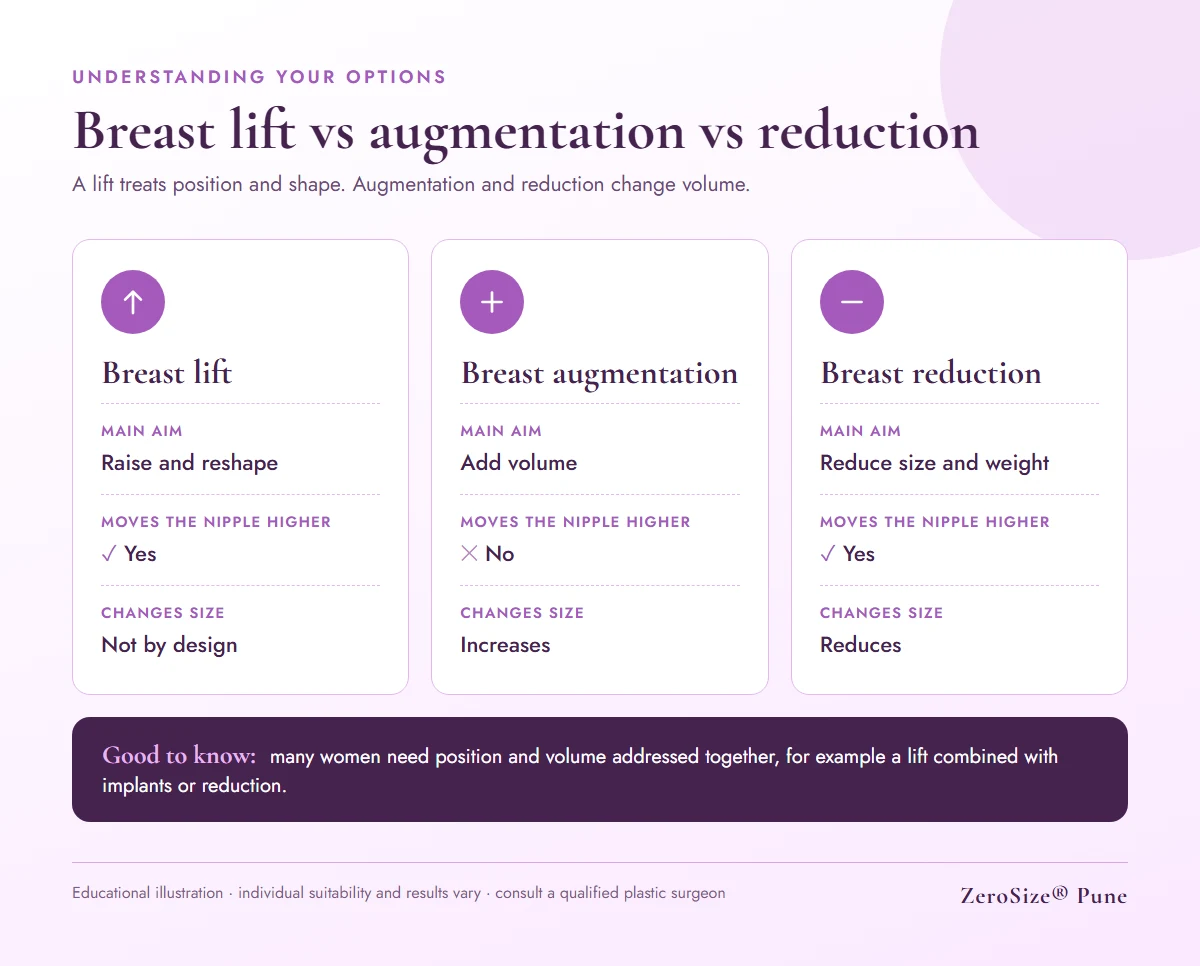
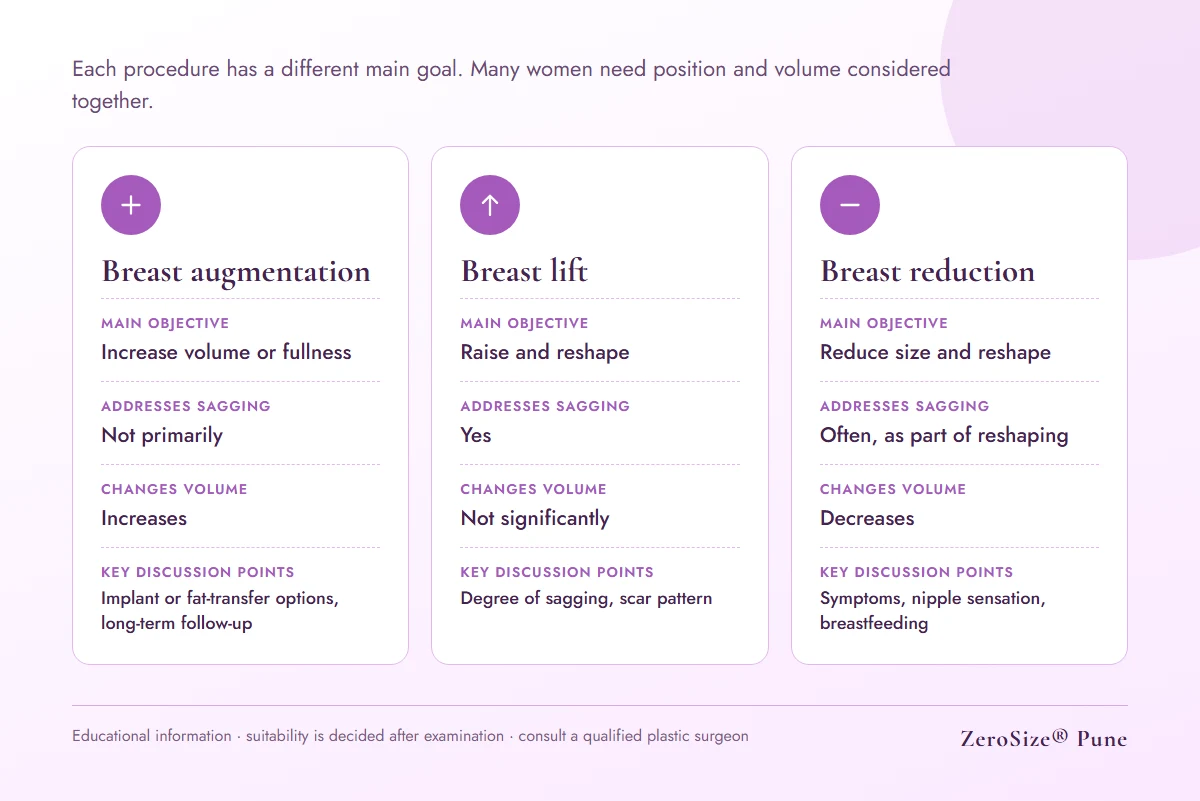
Breast augmentation versus breast lift
Breast augmentation primarily adds volume. A breast lift (mastopexy) addresses skin laxity, breast position and nipple position when appropriate. A patient who wants more fullness but has little sagging may be considered for augmentation alone. A patient with substantial drooping may need a lift, with or without an implant. Combined surgery may be considered in selected patients, but it involves different planning and risks.
Implants do not reliably lift a significantly drooping breast on their own. The consultation should explain the trade-offs of augmentation alone, lift alone or combined surgery. See our Breast Lift (Mastopexy) service page and guide comparing breast augmentation, lift and reduction.
Who may be a candidate for breast augmentation?
Candidate assessment considers whether the patient is an adult, has completed breast development, is in suitable general health, understands the procedure and risks, has realistic expectations and is making a voluntary decision. The surgeon reviews medical history, previous surgery, medication, allergies, nicotine use, breast examination, skin and tissue characteristics, asymmetry and relevant investigations.
Timing may be influenced by pregnancy, breastfeeding, planned future pregnancy, weight changes, existing breast symptoms or conditions and other medical factors. Surgery may be postponed or not recommended when risks outweigh potential benefits. The consultation is an opportunity to discuss alternatives, including no surgery.
Why consider Dr. Sheetal Londhe at Grace Aesthetics in Pune?
Choosing a plastic surgeon involves more than comparing photographs or implant brands. Patients should look for appropriate surgical qualifications, experience relevant to the procedure, a clear explanation of risks and alternatives, a properly equipped surgical setting, anaesthesia and postoperative support, transparent communication and the ability to ask questions without pressure.
Dr. Sheetal Londhe is presented at Grace Aesthetics as a female plastic surgeon with DNB training in Plastic Surgery and FACS (USA). Consultation is intended to address individual goals and anatomy, explain available procedures and discuss realistic expectations, risks and recovery. Patients should independently confirm credentials, facility details and the information provided during consultation before deciding on surgery.
For women who prefer to discuss breast surgery with a female surgeon, a private consultation may provide an opportunity to ask detailed questions about implant choice, breast function, future breastfeeding, sensation, scars, intimate concerns and follow-up. The decision to undergo surgery remains personal and should be based on informed consent.
What happens during the breast augmentation consultation?
- Discuss what you hope to change and what matters most to you.
- Review medical history, medication, allergies, previous surgery and relevant family or breast-health history.
- Examine breast anatomy, skin, tissue, chest measurements, asymmetry and nipple position.
- Discuss silicone, saline where available and suitable, and fat-transfer options.
- Review implant dimensions, profile, placement and incision choices.
- Discuss whether a lift or another procedure may be more appropriate or may need to be considered.
- Explain risks, limitations, scars, recovery, implant maintenance and future monitoring.
- Provide an opportunity to ask questions, consider alternatives and decide without pressure.
Preparing for breast augmentation surgery
Preparation is individualised. Your surgeon and anaesthesia team may provide instructions about medical tests, medicines, supplements, nicotine, fasting, bathing, clothing, transport, support at home and postoperative arrangements. Tell your team about health changes, infections, pregnancy possibility, allergies and all medications or supplements. Do not independently stop prescribed medication; follow the instructions from your treating team.
Plan to have help during the early recovery period if recommended. Arrange transport and avoid driving until you are medically cleared and no longer affected by anaesthesia, pain medication or restricted movement. Prepare a comfortable recovery space and follow the clinic’s instructions about garments, wound care and activity.
Recovery after breast augmentation
Recovery varies with the operation, individual healing, implant placement and other factors. Swelling, bruising, tightness, discomfort and temporary changes in sensation may occur. The surgeon provides instructions about support garments, incision care, showering, sleeping position, lifting, driving, work, exercise and follow-up. Patients should follow their own postoperative plan rather than a generic online timeline.
Breast shape and swelling may change as healing progresses. Avoid strenuous exercise, heavy lifting and activities that place pressure on the chest until the surgeon advises that it is safe. Attend follow-up appointments and contact the care team if symptoms concern you. Severe or rapidly worsening symptoms, chest pain, breathing difficulty, sudden swelling, fever or signs of significant infection warrant prompt medical assessment.
Risks and complications of breast augmentation
Breast augmentation is surgery and can involve complications. Potential risks include bleeding, infection, anaesthesia-related complications, pain, delayed healing, scarring, asymmetry, changes in breast or nipple sensation, implant malposition, rippling, capsular contracture, implant rupture or leakage, fluid collection, dissatisfaction, and the need for further surgery. Risks vary according to the patient, procedure and implant.
Implant-associated conditions and other uncommon but important risks should be discussed using current device-specific information. Patients should know what symptoms to report, what follow-up is recommended and how to obtain care if they experience a problem. No surgery is risk-free and no result can be guaranteed.
Breast implants and long-term follow-up
Breast implants are not lifetime devices. Some patients may require revision, removal or replacement because of complications, changes in preferences, ageing, pregnancy, weight change or other reasons. The timing and need for additional surgery cannot be predicted for every patient. Before surgery, ask about the specific implant, recommended monitoring, imaging, warranty information where applicable, signs of rupture or other complications and possible long-term expenses.
Breast implants do not eliminate the need for appropriate breast health assessment. Screening and imaging should be planned according to age, risk, symptoms and local recommendations, and imaging providers should know about the implants. If a patient develops a new lump, persistent swelling, pain, skin change or other breast symptom, she should seek medical assessment rather than assume it is implant-related or harmless. Patients can also review general breast implant safety information from the U.S. Food and Drug Administration (FDA), including implant risks, monitoring and patient information.
Breast augmentation cost in Pune
The cost of breast augmentation may depend on implant type and brand, operating facility, anaesthesia, surgeon’s plan, complexity, tests, postoperative care and follow-up. Fat transfer may have different cost factors because donor-site liposuction and processing are part of the procedure. Revision surgery may also differ in complexity and cost from primary augmentation. An accurate estimate should be provided after examination and discussion of the proposed procedure.
For a broader discussion of factors affecting prices, see the Breast Augmentation Cost in India guide. Avoid comparing quotations without checking what is included, the implant and facility details, follow-up arrangements and the surgeon’s proposed plan.
Breast augmentation in Pune: location and consultation
Grace Aesthetics is based in Pune and serves patients who are researching breast augmentation, implant surgery, breast lift and related procedures. Women from areas such as Viman Nagar, Kalyani Nagar, Koregaon Park, Kharadi, Hadapsar, Pune Camp, Deccan, Baner, Balewadi, Kothrud, Kondhwa and other parts of Pune may wish to arrange a consultation to discuss their goals and medical suitability. Patients travelling from elsewhere in Maharashtra or India should plan for preoperative assessment, postoperative visits and support during recovery.
Local search terms such as breast augmentation Pune, breast enlargement surgery Pune, breast implants Pune and augmentation mammoplasty Pune describe related topics, but a consultation is the best way to determine the procedure that may be appropriate for an individual patient.
Related breast surgery guides
- Breast Augmentation Surgery: Complete Guide — procedure overview and patient considerations.
- Breast Implants in India — implant types, safety, follow-up and considerations.
- Breast Augmentation Cost in India — factors that influence cost.
- Breast Augmentation vs Breast Lift vs Breast Reduction — understanding procedure differences.
- Breast Lift (Mastopexy) — treatment for selected concerns about breast position and skin laxity.
- Breast Reduction — a different procedure for reducing breast volume.
- Mommy Makeover — consultation for selected combinations of procedures after pregnancy-related changes.
Frequently asked questions about breast augmentation
What is breast augmentation?
Breast augmentation is surgery to increase breast volume or alter breast shape using implants or, in selected cases, fat transfer. The procedure and technique are chosen after assessment of anatomy, goals and health.
Who is suitable for breast augmentation?
Suitability is assessed individually. The surgeon considers adult status, breast development, health, medical history, anatomy, expectations, future pregnancy and breastfeeding plans, and the ability to understand risks and follow-up. Not everyone is a suitable candidate.
Can unmarried women undergo breast augmentation?
Being unmarried is not itself a medical contraindication. The decision should be voluntary and informed, and suitability depends on age, health, anatomy, goals, expectations and assessment by a qualified surgeon.
Will breast augmentation affect future breastfeeding?
Some patients breastfeed successfully after augmentation, while others may have difficulty or may not produce a full supply. Anatomy, breast tissue, pregnancy and surgical factors may influence breastfeeding. Discuss future plans and the proposed technique before surgery; no technique can guarantee breastfeeding ability.
Will breast augmentation affect nipple sensation?
Sensation may change temporarily or persistently after surgery. Surgical planning considers anatomy and nerve pathways, but altered or reduced sensation remains a possible risk. Discuss this before surgery.
Will breast implants affect my sexual life?
Breast augmentation is not intended to impair sexual function. Recovery, discomfort, sensation changes and personal experience can vary. Follow the surgeon’s advice about when breast contact and sexual activity may safely resume.
Where is the scar placed?
An inframammary incision may be placed in or near the natural crease beneath the breast when appropriate. Other incision approaches may be considered. Scar location, length and appearance depend on anatomy and surgical planning.
Will the scar fade?
Scars generally mature over months and may fade and soften, but their final appearance varies. Scar care and sun protection may be recommended. A scar cannot be guaranteed to become invisible.
What is the difference between silicone and saline implants?
Silicone gel implants contain cohesive gel; saline implants contain sterile saline inside a silicone shell. They differ in characteristics, feel, deflation presentation and availability. The surgeon should discuss the specific products and their risks and monitoring requirements.
Can fat transfer enlarge the breasts?
Fat transfer can add selected areas of breast volume in appropriately assessed patients. It typically offers a different degree and pattern of volume change than implants, and some transferred fat may not survive. Repeat treatment may be considered.
How do I choose breast implant size?
Size selection considers breast base width, chest dimensions, existing tissue, skin, projection, asymmetry and personal preferences. Cup size is not a precise surgical measurement. The surgeon should explain the trade-offs of the proposed implant dimensions.
Do implants lift sagging breasts?
Implants add volume but do not reliably correct significant sagging or nipple position. A breast lift may be needed, alone or in combination, depending on examination findings.
How long does recovery take?
Recovery depends on the procedure, implant placement, individual healing and work or activity demands. The surgeon provides specific instructions for activity, lifting, driving, work, exercise and follow-up. Do not rely on a fixed recovery timetable.
Are breast implants permanent?
No. Implants are not lifetime devices. Additional surgery may become necessary because of complications, changes in preferences or other reasons. Discuss follow-up, monitoring and long-term costs before surgery.
What are the risks of breast augmentation?
Risks can include bleeding, infection, anaesthesia-related complications, scarring, pain, changes in sensation, asymmetry, implant malposition, capsular contracture, rupture or leakage, dissatisfaction and additional surgery. Individual risks should be reviewed during consultation.
How much does breast augmentation cost in Pune?
Cost depends on the implant or technique, facility, anaesthesia, complexity, surgeon’s plan, tests and follow-up. An individual estimate should be provided after consultation. See the cost guide linked above for general factors.
Where can I consult Dr. Sheetal Londhe for breast augmentation in Pune?
Patients can request a consultation with Dr. Sheetal Londhe at Grace Aesthetics in Pune to discuss breast augmentation, implant selection, fat transfer, scars, recovery, risks and suitability. A consultation does not obligate a patient to proceed with surgery.
Begin with a private, informed consultation
Discuss your goals, anatomy, breast augmentation options, future considerations, recovery and risks with Dr. Sheetal Londhe at Grace Aesthetics, Pune.
Request an appointmentExplore our Breast Augmentation Guides
Explore related patient guides on implants, procedure planning, costs and breast-surgery comparisons.
Medical disclaimer: This page provides general educational information and does not replace examination, diagnosis or a personalised consultation. Breast augmentation is surgery and carries risks. Suitability, techniques, recovery and outcomes vary. Discuss benefits, alternatives, risks, implant-specific information, follow-up and future considerations with your surgeon before making a decision.