
Medically reviewed by Dr. Sheetal Londhe · Plastic Surgeon, Pune · NMC Reg. No. 2005042532 · Maharashtra Medical Council Reg. No. 2005/04/2532 · Last reviewed: 20 November 2026
Breast augmentation, breast lift and breast reduction are three different operations designed to address different breast concerns. Augmentation primarily adds volume; a lift reshapes and raises breast tissue and nipple position when appropriate; and reduction removes breast tissue and skin to decrease volume while reshaping the breast. Sometimes procedures are combined, but the appropriate plan depends on anatomy, symptoms, goals and medical assessment.
This guide explains the differences, possible benefits, limitations, scars, recovery, risks and questions to discuss with a qualified plastic surgeon. It is intended to help patients considering breast surgery in Pune make a more informed decision—not to replace an examination or individual advice.
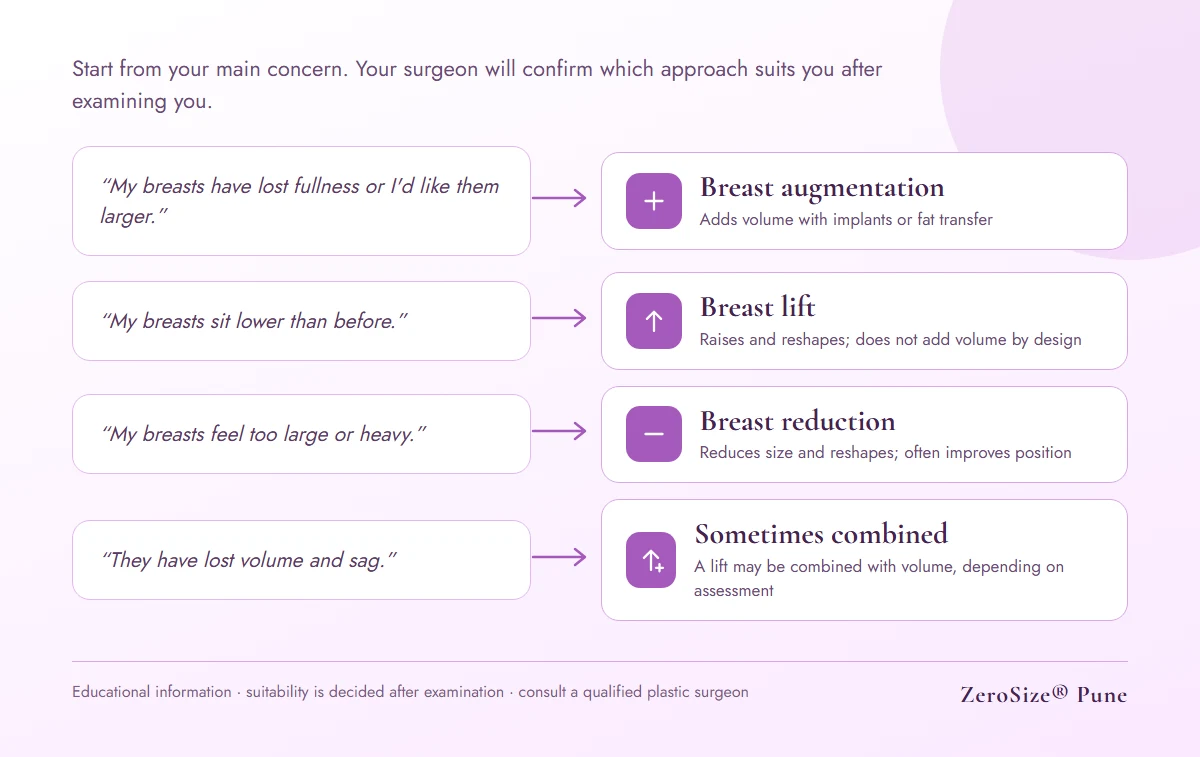
Quick answer: Which procedure addresses which concern?
| Procedure | Main purpose | Typical concern |
|---|---|---|
| Breast augmentation | Increase breast volume and fullness | Breasts feel small, lack fullness or volume has reduced |
| Breast lift (mastopexy) | Raise and reshape breasts | Drooping, stretched skin or nipple position |
| Breast reduction | Reduce volume and reshape | Large/heavy breasts, discomfort, skin irritation or activity limitations |
| Lift with augmentation | Raise/reshape while adding volume | Drooping plus desire for greater fullness |
This is a general guide. Breast shape, skin quality, tissue distribution, nipple position, medical history and expectations influence surgical planning.
Why breast shape and size change
Breast tissue contains glandular tissue, fat, connective tissue and skin. Its volume, shape and position vary naturally. Changes may occur throughout life and do not necessarily mean surgery is needed.
Pregnancy and breastfeeding
Breasts may enlarge during pregnancy and lactation, then change in volume after breastfeeding. Skin stretching and changes in tissue fullness may contribute to a different shape or position.
Weight fluctuation
Weight gain or loss can change the amount of fat within the breast. Significant weight loss may leave skin with less ability to retract, while weight gain may increase breast volume or heaviness.
Ageing and genetics
Skin elasticity, connective tissue and breast composition are influenced by genetics and ageing. These factors contribute to individual differences in shape, firmness and position.
Breast size and symptoms
Very large breasts may be associated with shoulder grooves from bra straps, neck or back discomfort, skin irritation under the breast fold or difficulty participating in some activities. Symptoms deserve clinical evaluation.
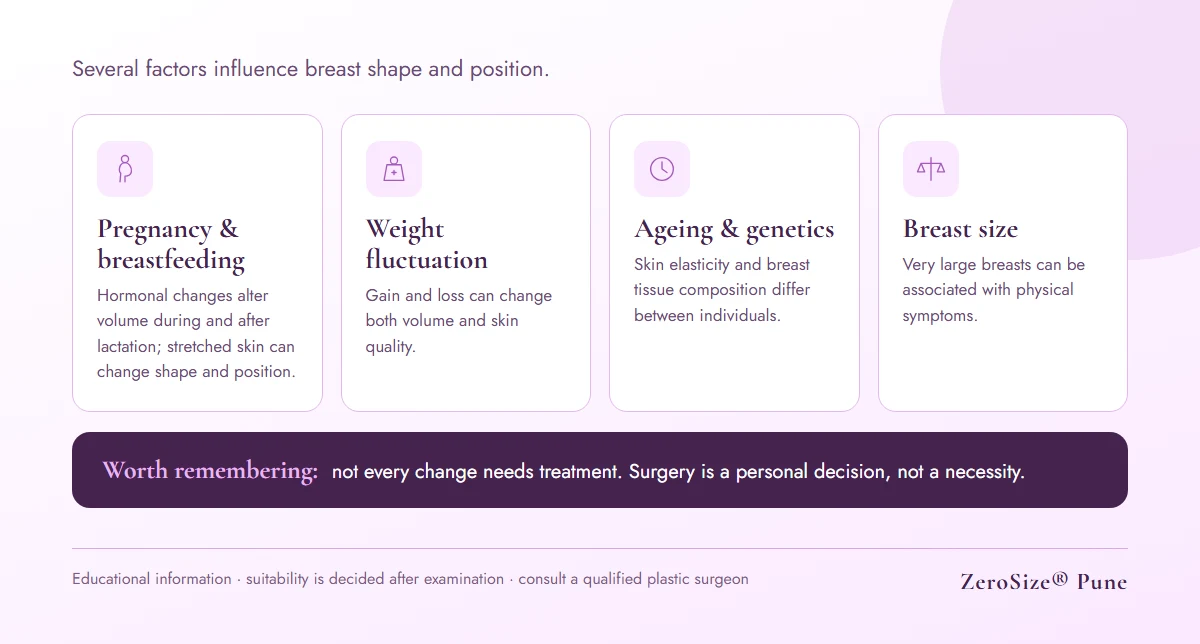
Not every change requires treatment. Surgery is a personal choice, and a consultation should include the option of no surgery as well as alternatives.
What is breast augmentation?
For a detailed overview of breast augmentation surgery, implant options, planning, recovery and consultation in Pune, visit our Breast Augmentation Surgery in Pune guide.
Breast augmentation (augmentation mammoplasty) is intended primarily to increase breast volume or fullness. Depending on anatomy and goals, augmentation may involve implants or, in selected circumstances, fat transfer. Technique, implant type, placement and incision are decisions made during a detailed consultation.
What breast augmentation may address
- Desire for increased breast volume
- Loss of fullness after pregnancy, breastfeeding or weight change
- Differences in breast volume, where a plan may aim to improve balance
- Selected reconstructive or other clinical indications
What augmentation does not primarily do
Augmentation is not primarily a procedure for raising a significantly drooping breast or correcting excess skin. Added volume may not adequately reposition the nipple or reshape loose skin. When sagging is a major concern, a lift may be discussed, either alone or with augmentation.
Implant-related discussion
Patients considering implants should understand implant size, shape, material, placement, incision options, expected appearance, limitations and long-term follow-up. Implants are not lifetime devices and may require monitoring, replacement or further surgery. Potential complications include capsular contracture, rupture, infection, implant malposition, asymmetry, changes in sensation and other implant-related concerns.
Fat transfer augmentation
Fat transfer uses fat harvested from another area of the body and processed for transfer. It may be suitable for selected patients seeking a modest change, but fat survival and volume retention are variable. It may involve more than one treatment and is not suitable for everyone.
What is a breast lift (mastopexy)?
A breast lift reshapes the breast and removes excess skin to improve breast position. Depending on anatomy and technique, the nipple-areola complex may be repositioned. Mastopexy is often discussed when breast skin has stretched or the breast has descended after pregnancy, breastfeeding, ageing or weight changes.
What a lift aims to change
- Breast position and contour
- Excess or lax skin
- Nipple-areola position, when indicated
- Shape and distribution of breast tissue
A lift does not primarily increase breast volume. It may create a more compact or reshaped contour, but cannot guarantee a particular cup size or symmetry. Scars are part of the operation, and their pattern depends on the degree of skin excess and technique.
Lift techniques and scars
Scar patterns may include scars around the areola, vertically from the areola toward the breast fold, and/or along the inframammary fold. The pattern is selected based on anatomy and the amount of reshaping required. Scar appearance evolves over months and varies between individuals.
When augmentation may be combined with a lift
Some patients have both reduced fullness and sagging. Combined augmentation-mastopexy may be considered to raise and reshape while adding volume. This is a more complex planning decision; the balance between skin tightening and implant volume, tissue healing, risks and the possibility of staged surgery must be explained individually.
What is breast reduction?
Breast reduction (reduction mammoplasty) removes breast tissue and skin and reshapes the remaining tissue to create a smaller breast. Goals may include reducing weight and volume, improving contour and addressing symptoms associated with large breasts. A medical assessment is needed to determine whether symptoms are related to breast size and whether surgery is appropriate.
Concerns that may lead someone to discuss reduction
- Neck, shoulder or back discomfort
- Grooves or discomfort from bra straps
- Skin irritation or rashes beneath the breast fold
- Difficulty with exercise, daily activities or clothing fit
- Desire for smaller breasts and a proportionate shape
Reduction involves scars and can affect nipple sensation and breastfeeding ability. The amount removed and final size cannot be guaranteed. Discuss techniques, healing, risks, alternatives and priorities with the surgeon.
Read more about breast reduction surgery.
Breast augmentation vs breast lift vs breast reduction: detailed comparison
| Feature | Augmentation | Lift | Reduction |
|---|---|---|---|
| Primary goal | Add volume | Raise and reshape | Reduce volume and reshape |
| Removes breast tissue | Usually no | May remove skin and reshape tissue | Removes tissue and skin |
| Implant generally required? | May be, depending on plan | No | No |
| Addresses sagging? | Not reliably on its own if significant | Primary purpose | Often reshapes and may improve position |
| Volume change | Increase | Not primarily an increase | Decrease |
| Scars | Incision scars; location depends on technique | Lift-related scar pattern | Reduction-related scar pattern |
| Breastfeeding impact | Possible; discuss | Possible; discuss | Potential impact; discuss carefully |
| Long-term considerations | Implant surveillance/future surgery if implants used | Shape may change with ageing, pregnancy and weight | Shape, symptoms and weight may change |
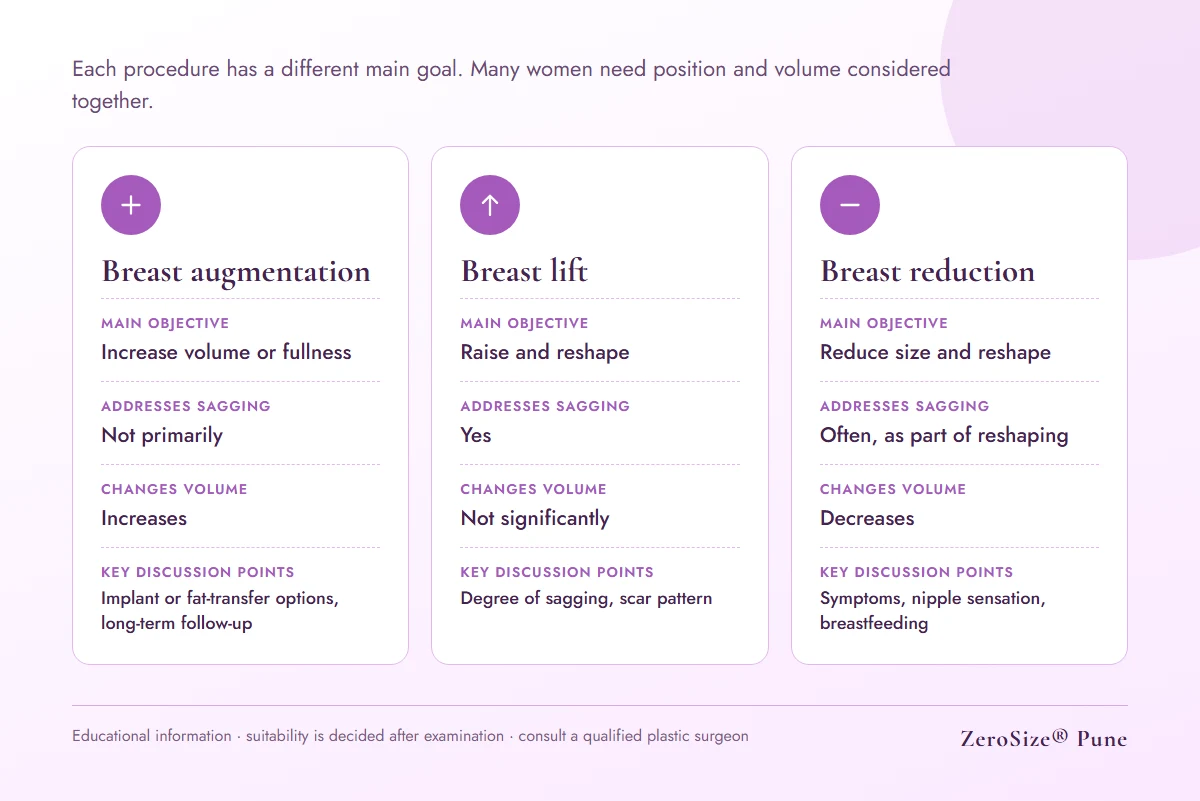
How a surgeon assesses which operation may be suitable
There is no single measurement or photograph that determines the right operation. Assessment may include medical history, breast measurements, skin quality, tissue distribution, nipple position, asymmetry, symptoms, goals and examination. The discussion may also cover medications, nicotine use, medical conditions, previous breast surgery, screening history and plans for future pregnancy or breastfeeding.
When the main goal is added fullness
Augmentation may be discussed when volume or fullness is the principal concern and skin and breast position are appropriate. If significant sagging is present, augmentation alone may not meet the goals.
When the main goal is improved position
A lift may be considered when excess skin or breast descent is the primary concern. The surgeon will explain scar patterns and the limits of reshaping.
When the main goal is reducing heaviness or volume
Reduction may be discussed when breast size is associated with symptoms or when the patient wishes to reduce volume. Symptom evaluation and individual surgical assessment are important.
When concerns overlap
Patients may have more than one concern. A combination or staged approach may be considered, but combining procedures is not automatically preferable. Safety, operative duration, healing and risk profile must be considered.
Timing: breastfeeding, pregnancy and weight stability
Breast size and shape may continue to change with pregnancy, breastfeeding and weight fluctuation. Patients are generally advised to discuss timing after breastfeeding and allow breast volume to settle before elective planning. Stable weight can help planning. Future pregnancy may alter results, and surgery can affect breastfeeding depending on the procedure and technique. Individual recommendations should be made by the treating surgeon.
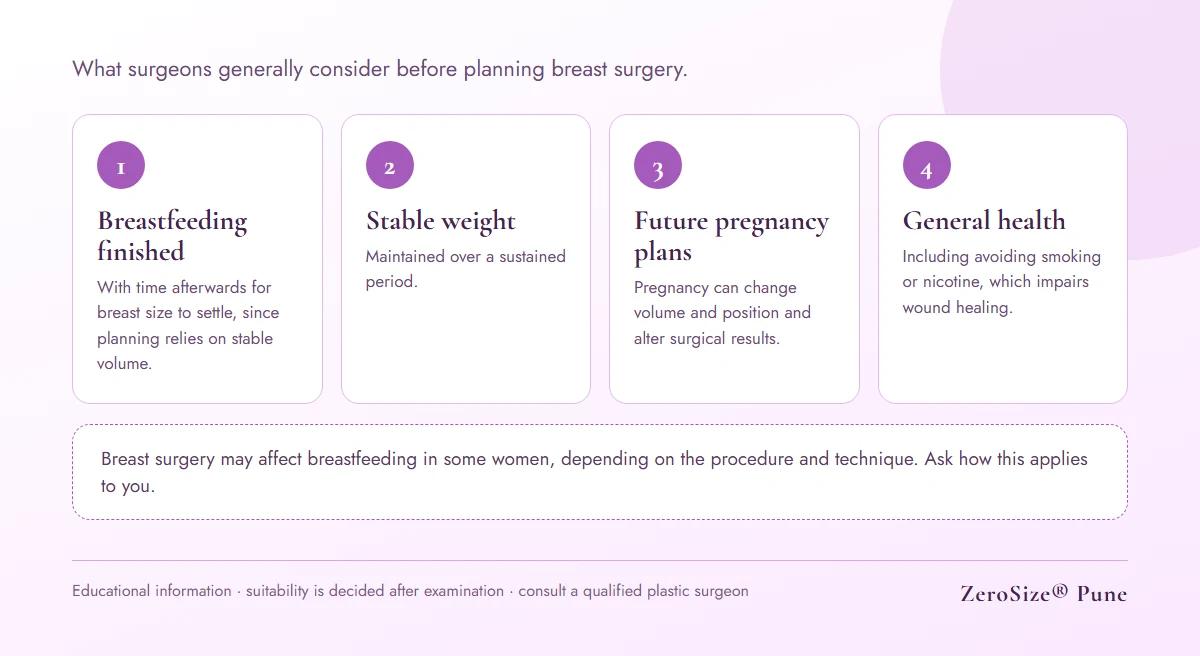
Risks, limitations and recovery
All breast operations carry risks. These can include bleeding, infection, anaesthesia-related complications, wound-healing problems, scars, asymmetry, altered nipple or breast sensation, changes in nipple or skin blood supply, blood clots and possible further surgery. Risks differ by procedure and patient.
Recovery considerations
Recovery varies. Patients may need help at home initially, prescribed pain management, wound care, support garments where advised, activity restrictions and scheduled follow-up. Heavy lifting, strenuous exercise and certain movements may be restricted for a period determined by the surgeon. Follow personalised instructions rather than relying on a generic timeline.
Warning signs
Contact your surgical team promptly if you develop concerning symptoms such as worsening pain, fever, increasing redness, unusual drainage, sudden swelling or wound changes. Severe shortness of breath, chest pain, fainting or other emergency symptoms require urgent medical care.
Questions to ask during a breast surgery consultation
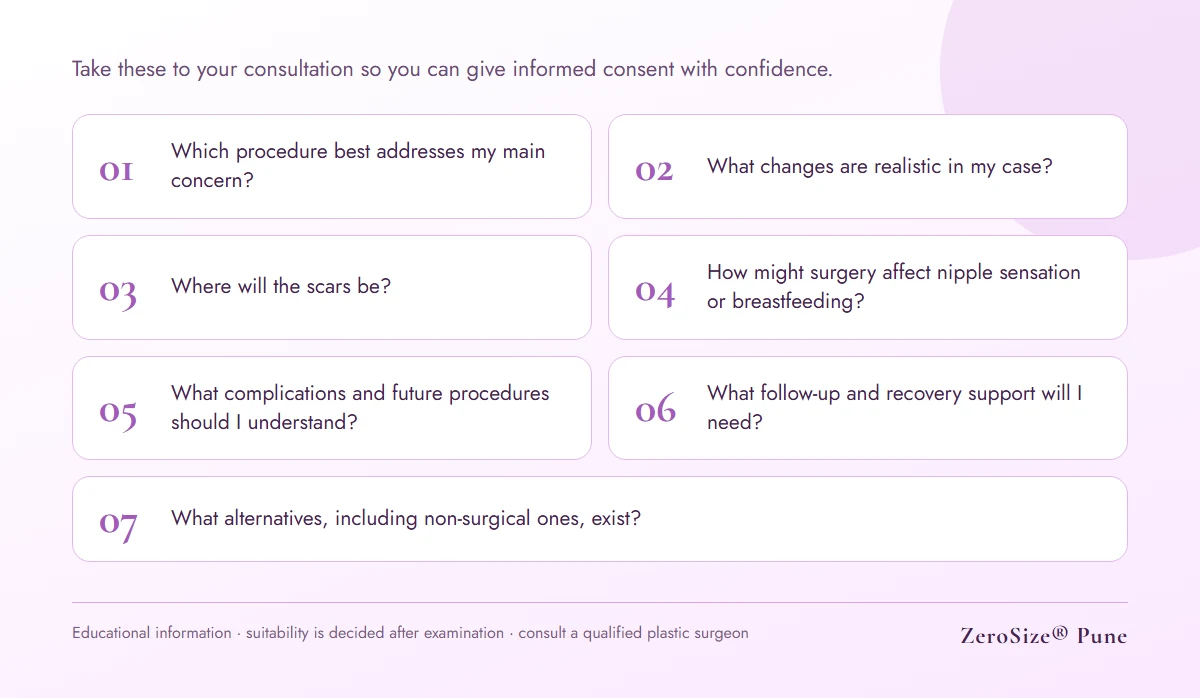
- Which operation best addresses my primary concern and why?
- What is realistic for my anatomy and goals?
- What scar pattern is likely and how should scars be cared for?
- How could the procedure affect nipple sensation or breastfeeding?
- What complications are most relevant to me?
- Would a combined or staged operation be safer or more appropriate?
- What follow-up, restrictions and recovery support will I need?
- What alternatives—including no surgery—should I consider?
- What costs are included in the estimate and what may vary?
About the reviewing surgeon
Dr. Sheetal Londhe is a female plastic surgeon practising in Pune. A consultation is an opportunity to discuss goals, anatomy, medical history, options, limitations, risks and recovery in a confidential clinical setting.
- National Medical Commission (NMC): 2005042532
- Maharashtra Medical Council: 2005/04/2532
Medical disclaimer: This article is for general education and does not replace a consultation, examination or personalised medical advice. Suitability, technique, risks and recovery must be assessed by a qualified plastic surgeon and anaesthesia team.
Understanding Cosmetic Surgery Cost Estimates
Costs depend on the procedure and individual treatment plan, clinical complexity, surgeon and anaesthesia requirements, hospital and room arrangements, investigations, medicines, garments and follow-up. For general approximate procedure-wise ranges and a broader explanation of pricing in Pune, see the Cosmetic Surgery Cost in Pune guide (Post 7777). This article focuses on procedure considerations, not a separate price table. A personalised estimate follows assessment.
Frequently asked questions
Can a breast lift increase breast size?
A lift primarily raises and reshapes breasts and does not provide the volume increase associated with augmentation. Some patients discuss combining a lift with augmentation when they want both changes.
Can breast augmentation correct sagging?
Implants add volume but may not adequately correct significant drooping. Depending on examination, a lift may be discussed.
Can breast reduction affect breastfeeding?
Breast reduction may affect milk production or breastfeeding ability. The effect depends on technique and individual factors, so future breastfeeding plans should be discussed before surgery.
Is breast surgery necessary after pregnancy?
No. Breast changes after pregnancy and breastfeeding are common. Surgery is optional and should be based on goals, health and informed choice.
Which procedure has the shortest recovery?
Recovery depends on the operation, technique, individual health and any combined procedures. Your surgeon should provide a tailored recovery plan rather than a universal timeline.
Can augmentation, lift and reduction be combined?
Some procedures may be combined in selected patients, such as augmentation with a lift. Combining operations requires careful evaluation of safety, healing and goals; staged surgery may sometimes be advised.
Will scars disappear?
Scars are permanent, although their appearance often changes and may fade over time. Scar quality varies. Your surgeon can explain the expected scar pattern and care.
How do I choose between augmentation, lift and reduction?
Start with your main concern—volume, position or heaviness—but final planning requires examination, medical history, realistic goals and discussion of risks and alternatives with a qualified plastic surgeon.
Related guides
- Breast Reduction Surgery
- Mommy Makeover in Pune
- Tummy Tuck and Breast Lift in Pune: Combined Surgery Explained
- Dr. Sheetal Londhe – Female Plastic Surgeon in Pune
- Abdominoplasty in India
Discuss breast surgery options at ZeroSize® by Grace Aesthetics, Pune
ZeroSize® by Grace Aesthetics is located in Viman Nagar, Pune. Patients considering breast augmentation, breast lift, breast reduction or a combination can discuss their concerns and treatment options with Dr. Sheetal Londhe. The consultation should include realistic goals, suitability, risks, limitations, recovery, follow-up and alternatives.
Patients travelling from Kharadi, Koregaon Park, Kalyani Nagar, Hadapsar, Baner, PCMC and other parts of Pune can plan an appointment at the Viman Nagar clinic. Patients travelling from outside Pune should discuss travel and postoperative follow-up arrangements in advance.
Related breast surgery guide: Breast Lift Questions Answered: 49 Questions about Mastopexy, Recovery, Scars and Consultation in Pune — explore patient questions about breast lift surgery, candidacy, techniques, recovery, risks and consultation planning.
Related Breast Surgery Guides
Explore the Breast Lift (Mastopexy) service in Pune, the comprehensive Breast Lift guide, Breast Lift vs Augmentation vs Reduction, and treatment options for sagging breasts. If combined surgery is being considered, read Tummy Tuck and Breast Lift in Pune or the Mommy Makeover overview.
Related Breast Reduction Guides
When Breast Reduction Is Considered for Symptoms or Recovery Planning
Breast reduction is different from a lift or augmentation in its aims and tissue-removal approach. For more detail on indications, recovery, scars and consultation planning, see the Breast Reduction Surgery guide and our Breast Reduction in Pune pillar.
6 Responses