
Pregnancy does more to the breasts than change their size. The sustained stretch of the skin envelope, weight changes during nursing, and the involution that follows weaning frequently leave the breasts lower on the chest wall than before — with skin that no longer retracts and a nipple position that sits below the natural breast fold.
Surgeons call this ptosis — the medical term for drooping — and it is extremely common after one or more pregnancies, significant weight change, or simply age and gravity.
A breast lift (mastopexy) raises sagging breasts by removing excess skin and tightening the tissue beneath it. The nipple and areola are moved higher, and a stretched areola can be made smaller. It is a reshaping procedure, not a volume procedure — if your main concern is that your breasts have become smaller, see our pages on breast augmentation or a combined mommy makeover.
Breast lift at a glance
What it does
Raises and reshapes sagging breasts by removing excess skin and repositioning the nipple and areola
What it does not do
Add volume — that needs implants or fat transfer, alone or combined with a lift
Anaesthesia
Usually general anaesthesia
Surgery time
Typically about 2 to 3 hours
Hospital stay
Same-day discharge or an overnight stay, depending on technique and your surgeon's protocol
Bruising, swelling, soreness
Usually settle over 1 to 2 weeks
Final shape
Settles over a few months — scars keep fading for a year or more
Cost in Pune
Depends on technique and whether implants or reduction are combined — ask for a personalised quote at consultation
What Is a Breast Lift (Mastopexy)?

A breast lift is a surgical procedure that removes excess, stretched skin from the breast envelope, reshapes and elevates the glandular tissue so it sits higher on the chest wall, repositions the nipple-areola complex to a more natural position, and reduces the areola if it has enlarged. The result is breasts that sit higher, are firmer in contour, and have a more youthful profile — without necessarily changing their size.
Breasts sag when the skin and the ligaments supporting them stretch. Pregnancy and breastfeeding, weight change, ageing and gravity are the common causes, and genetics plays a part too. A lift treats the sag — it does not add volume, so it is not the answer if your main concern is that your breasts have become smaller or lost fullness at the top.
It is an elective operation performed under general anaesthesia, so treat it as major surgery even though many patients go home within a day.
Breast lift vs. breast augmentation vs. breast reduction
Breast lift
Breast augmentation
Breast reduction
Main aim
Raise and reshape
Add volume
Reduce size and weight
Moves the nipple higher
Yes
No
Yes
Changes size
Not by design
Increases
Reduces
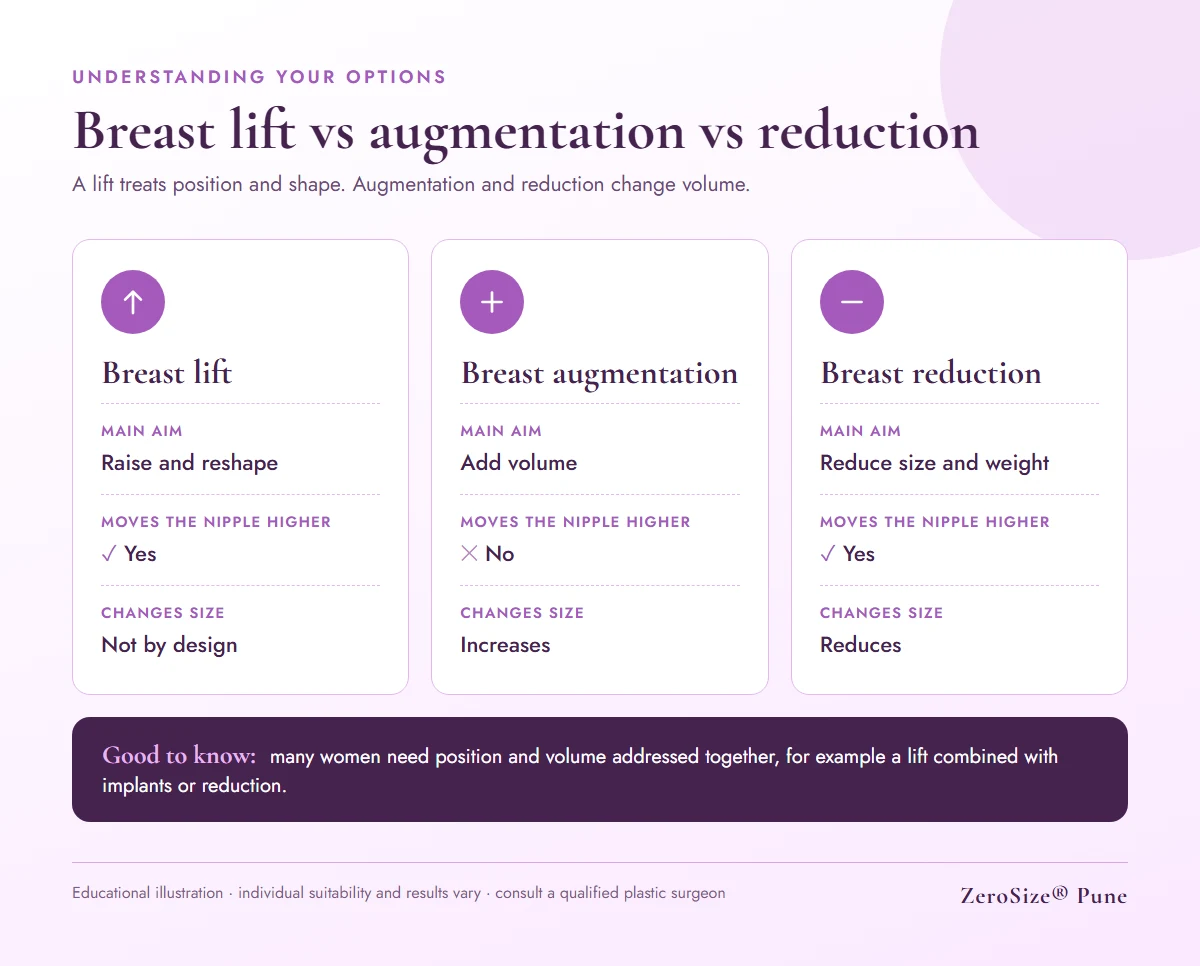
Many women need position and volume addressed together — see combining a lift with implants or reduction further down this page.
Do You Need a Breast Lift? How Sagging Is Graded
Surgeons grade sagging (ptosis) by where the nipple sits relative to the inframammary fold — the crease beneath the breast. The widely used Regnault scale works like this:
- Grade 1 (mild): the nipple is at, or about at, the level of the fold.
- Grade 2 (moderate): the nipple is below the fold but is not the lowest part of the breast.
- Grade 3 (severe): the nipple is below the fold and is the lowest part of the breast, often pointing downward.
- Pseudoptosis: the nipple is at or above the fold, but breast tissue hangs below it.
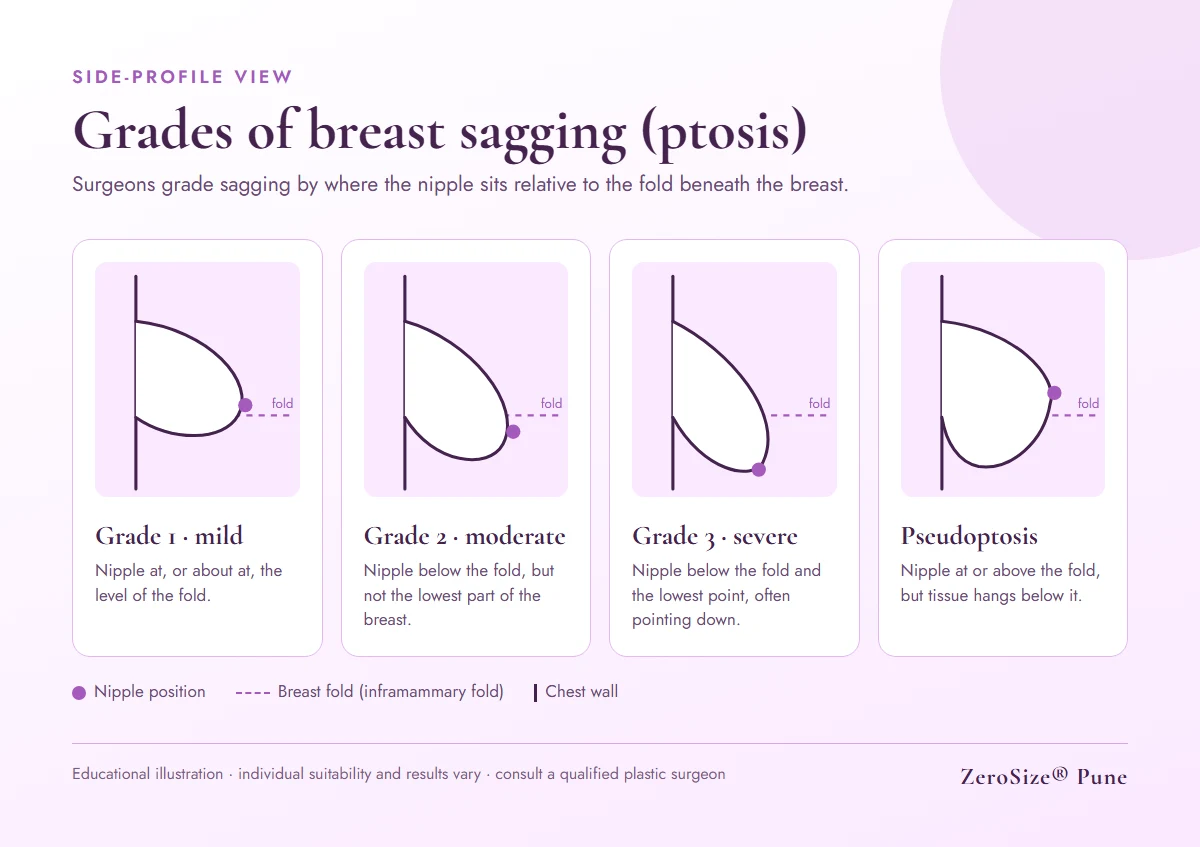
A rough check: stand side-on to a mirror with your arms relaxed and find the crease under your breast. Where does the nipple sit compared with that line? This is only a guide — breast volume, skin quality and areola size also decide what is right for you, so only an in-person assessment can tell you whether you need a lift, an implant, or both.
Who Is a Good Candidate, and Who Should Wait
Good candidates generally:
- Have breasts that sag, or nipples that sit below the fold or point downward
- Are bothered by stretched skin or enlarged areolas
- Are in good general health and at a stable weight
- Do not smoke — smoking harms healing, so surgeons ask smokers to stop well before surgery
- Have fully developed breasts and realistic expectations
Think about timing if you:
- Are planning a pregnancy — pregnancy and breastfeeding can change breast shape again, and significant weight change can undo some of a lift
- Are still gaining or losing weight
- Smoke
There is no single ideal age. The practical requirements are developed breasts, good general health and a stable weight — Dr. Sheetal Londhe will talk through your own timing at consultation.
Types of Breast Lift and the Scars Each Leaves
Your surgeon chooses a technique based on breast size and shape, the size and position of the areolas, how much the breasts sag, and the quality of the skin. In general, more sagging needs more skin removed, which means longer scars.
Technique
Incision
Typically suits
Scar
Crescent lift
Small half-moon above the areola
Very mild sagging or a small nipple adjustment
Short, at the upper edge of the areola
Periareolar (doughnut)
Circle around the areola
Mild to moderate sagging with little excess skin below the nipple
Around the edge of the areola
Vertical (lollipop)
Around the areola and straight down to the fold
A wide range of sagging, mild to severe
Around the areola plus a vertical line, no horizontal scar
Anchor (inverted-T)
Around the areola, down, and along the fold
Significant sagging — the most common standard pattern
Longest, includes a line in the fold
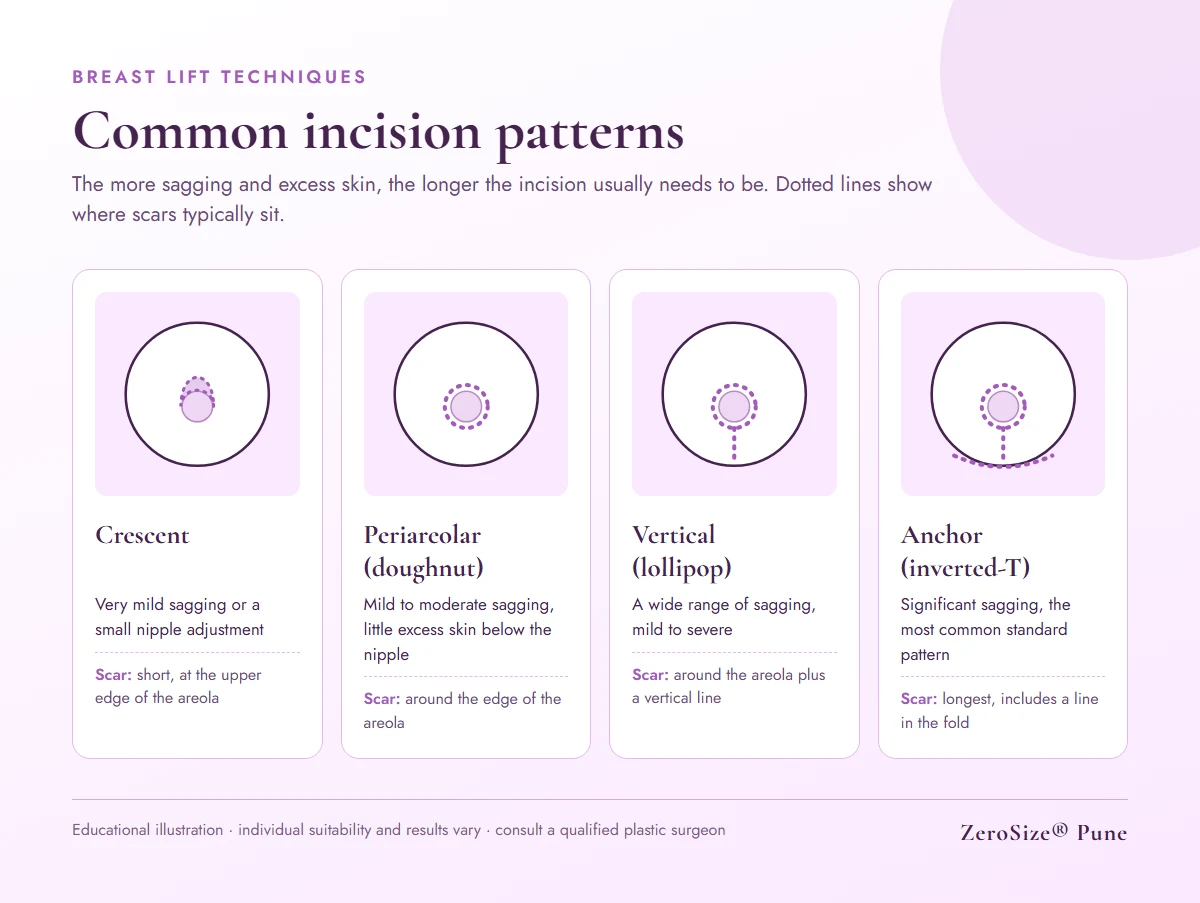
Scars are permanent but fade. Most of the fading happens within about a year, and scars can keep softening for up to 18 months. Some scars heal wide or thick; if that happens, they can often be improved once the scar has matured.
Combining a Lift With Implants or Reduction
If your breasts have lost volume as well as position, a lift can be combined with implants (augmentation-mastopexy). Fat transfer can restore volume in selected patients. Implants can be placed at the same time as the lift or as a second procedure — combining the two can mean added risk and sometimes more than one operation, so ask your surgeon which approach they recommend for you, and why.
If your breasts are large and heavy, a breast reduction also lifts them.
What Happens: Before, on the Day and After
Before
Your surgeon takes your medical history, examines your breasts, measures and photographs them, and discusses technique and scars. A baseline mammogram may be advised, with another some months after surgery. You will be asked to avoid aspirin and anti-inflammatory medicines that increase bleeding, and smokers will be asked to stop well in advance.
On the day
The operation is usually done under general anaesthesia and takes about 2 to 3 hours. The surgeon removes excess skin, reshapes the breast tissue, and repositions the nipple and areola higher, keeping them attached to the underlying tissue to protect blood supply and, as far as possible, sensation and milk ducts. Drains may be placed, and you wake in a support bra or dressings.
Hospital stay
Practice differs — some patients are discharged the same day, others are kept overnight or for a day or two, depending on the technique and your surgeon's protocol.
Recovery Week by Week
Plan for someone to drive you home and stay with you the first night. The timeline below is typical — your surgeon's own instructions always come first.
When
What to expect
Days 1 to 3
Soreness and tightness. Rest with your upper body raised, wear the surgical bra, walk gently around the house to reduce clot risk, and avoid lifting anything heavy
Week 1
Bruising, swelling and soreness are at their worst. First follow-up for dressings and any drain
Weeks 2 to 3
Swelling improves noticeably. Many patients return to desk work and light activity
Weeks 4 to 6
Gradual return to exercise. Avoid heavy lifting and strenuous upper-body exercise until cleared, often around 4 to 6 weeks. Keep wearing a support bra for several weeks
Months 3 to 6
Breasts settle into their final shape and scars keep maturing. Numbness can linger, sometimes up to a year
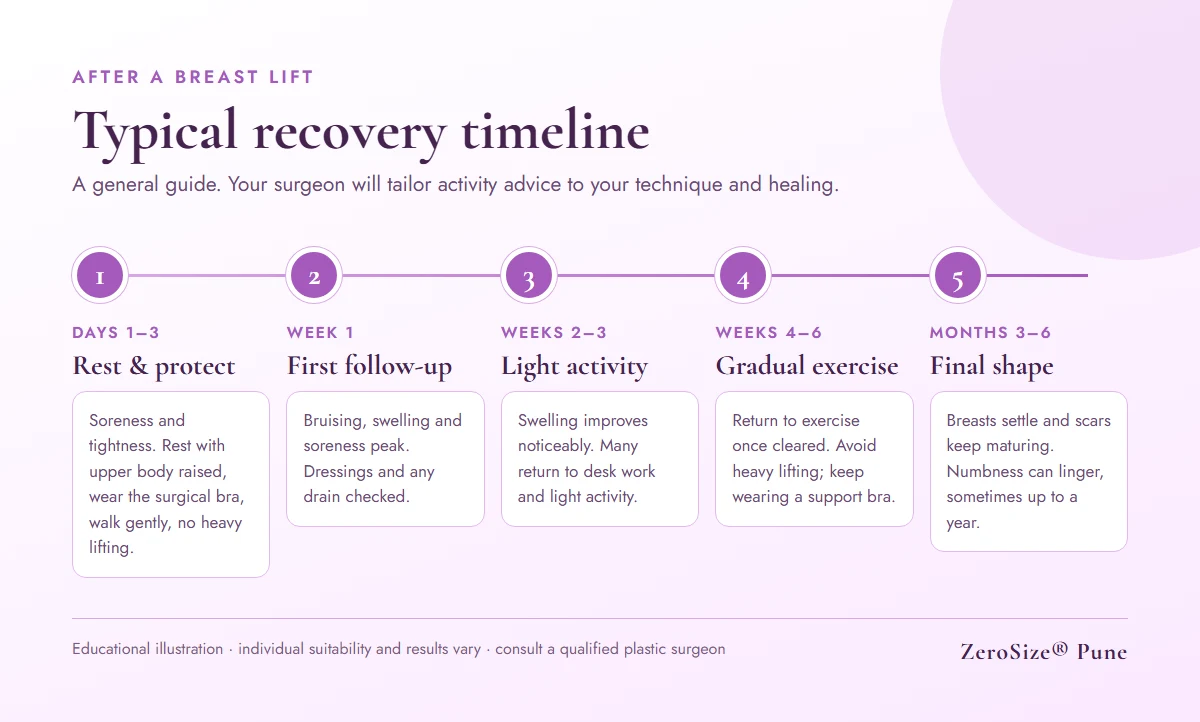
Do not drive until your surgeon says you can. If you are travelling to Pune from another city, ask how long you should plan to stay for follow-up.
Results: How Long a Lift Lasts
The result is visible straight away, and the shape keeps refining over several months. A lift is long-lasting, but it does not stop ageing or gravity, so breasts can keep changing. A stable weight helps you keep the result, while major weight change or another pregnancy can bring some sagging back. Recurrence of sagging and the need for revision surgery are recognised possibilities.
Breastfeeding, Pregnancy and Mammograms After a Lift
Breastfeeding
A lift can affect milk production for some women, and the effect cannot be predicted in advance. Surgeons try to keep the nipple attached to the underlying breast tissue to protect it, but research on breastfeeding after mastopexy is limited and mixed. Be cautious of any clinic that promises breastfeeding will be unaffected. If you plan more children, say so at your consultation.
Pregnancy
A later pregnancy can change your breasts again. Ask your surgeon how a future pregnancy might affect your result.
Mammograms
A breast lift does not stop you having mammograms — tell the technician about your surgery. A baseline mammogram before surgery and another some months afterwards is a reasonable precaution. Keep up routine screening as your doctor advises.
Risks and Complications
Significant complications are infrequent, but every operation carries risk. Here is what to watch for:
Risk
What it means
What helps, and when to call
Bleeding or haematoma
Blood collecting under the skin, sometimes needing drainage
Follow activity limits. Call if swelling grows quickly on one side
Fluid collection (seroma)
Fluid building up under the skin
Follow-up checks — may need draining
Infection
Redness, warmth, fever or discharge
Antibiotics where prescribed. Call early
Poor wound healing
Slow healing, wider scars
Not smoking and careful wound care
Change in nipple or breast sensation
Numbness, usually temporary and rarely permanent
Often returns over weeks to months, sometimes up to a year
Asymmetry or contour irregularity
Uneven shape or nipple position
Some cases need revision
Fat necrosis
Firm lumps where fatty tissue has lost its blood supply
Needs review
Nipple and areola blood supply
Rarely, partial or total loss
The most serious local risk — call at once if a nipple turns dusky or very dark
Anaesthesia, clots, heart and lung complications
General surgical risks
Early walking. Tell your team about medical conditions and medicines
Call your surgeon straight away for fever, rapidly increasing swelling or pain on one side, spreading redness or discharge. Chest pain, breathlessness or a painful, swollen calf needs emergency care.
Cost of a Breast Lift in Pune
The exact cost depends on your anatomy, the technique used, and whether implants or a reduction are combined with the lift — book a consultation for a personalised quote. What drives the price:
- The surgeon's experience
- The technique — an anchor lift takes longer than a doughnut lift
- Whether implants or a reduction are added
- Anaesthesia and operating-theatre charges
- The hospital stay
- Garments, medicines and follow-up visits
When you compare quotes, ask whether the figure includes the surgeon's fee, anaesthesia, theatre, stay, follow-up visits and the revision policy. Cosmetic breast lifts are generally not covered by health insurance — confirm with your insurer.
Can You Lift Sagging Breasts Without Surgery?
Only slightly, and only when sagging is mild. Radiofrequency, laser and thread treatments aim to tighten skin and stimulate collagen, but their results are modest and cannot match surgery. These treatments cannot remove excess skin, so the lift they offer is limited. If your nipple sits below the fold, surgery is the option that addresses the cause. Our guide to breast tightening treatment compares every option.
How to Choose a Breast Lift Surgeon in Pune
Look for a recognised plastic surgery qualification (MCh or DNB in Plastic Surgery) and a valid medical registration you can verify with the state medical council or the National Medical Commission. Questions worth asking:
- How many breast lifts do you perform each year?
- Which technique would you use for me, and why?
- Where will the surgery be done, and is the facility accredited (for example, NABH)?
- How are complications handled?
- How might surgery affect breastfeeding?
- Can I see before-and-after photos of patients similar to me?
Frequently Asked Questions
Is a breast lift major surgery?
Yes. It is performed under general anaesthesia and involves reshaping breast tissue, even though many patients go home within a day.
Will a breast lift change my breast size?
Not by design. A lift changes position and shape. Breasts can look a little smaller or firmer because skin is removed, and larger if implants are added.
How long does a breast lift last?
Results are long-lasting but not permanent. Ageing, gravity, weight change and pregnancy can bring some sagging back.
Will there be visible scars?
Yes. Scars are permanent, but they are placed around the areola, down the breast, and sometimes in the fold, and they fade substantially over the first year or more.
Is the surgery painful?
Discomfort is usually manageable with prescribed pain relief, mostly in the first week.
When can I return to work, drive or exercise?
Many women return to desk work in 2 to 3 weeks, while jobs involving lifting or physical work usually need 4 to 6 weeks. You can usually drive after 1 to 2 weeks, once you are off strong painkillers and can brake suddenly without pain. Walking helps from day one, and strenuous upper-body exercise usually waits until around 6 weeks. Your surgeon's instructions come first.
Can I breastfeed after a breast lift?
Some women can, but it cannot be guaranteed. Discuss your plans with your surgeon before surgery.
Can I have a lift and implants together?
Often yes, but some surgeons stage them as two separate operations for safety. Ask which approach is right for you.
What is a doughnut mastopexy?
A periareolar lift with an incision only around the areola. It suits a small lift without reshaping the breast.
What is the best age for a breast lift?
There is no single best age. What matters is that your breasts are fully developed, your weight is stable and you are in good general health. Many women choose it after having children, but it can suit younger or older women too.
Can I get a breast lift before marriage or before having children?
Yes, if your sagging bothers you now. A later pregnancy and breastfeeding can change your breasts again and may undo part of the lift, so some women choose to wait. Discuss your plans openly at consultation.
Can I have a breast lift if I have diabetes or thyroid problems?
Often, yes, as long as the condition is well controlled. Uncontrolled diabetes slows wound healing and raises infection risk, so your blood sugar (HbA1c) will be checked first. Thyroid levels should be normal on medication. Tell your surgeon about every condition and medicine.
Can only one breast be lifted?
Yes. If one breast hangs lower, the surgeon can lift only that side, or lift both by different amounts to improve symmetry. Perfect symmetry is not possible, because no two breasts are identical even naturally.
What is the 45-55 breast rule?
It is a proportion many surgeons use as a guide to a natural-looking breast: about 45% of the volume sits above the nipple and 55% below it, with the nipple pointing slightly upward. It is a planning guide, not a rule every breast must meet.
Are nipples removed during a breast lift?
In a standard breast lift, no. The nipple and areola stay attached to the breast tissue underneath and are moved up, which protects their blood supply. Free nipple grafts are only used in rare cases of very large breasts.
Will I be awake? Can it be done under local anaesthesia?
A full breast lift is done under general anaesthesia, so you are asleep. A very small crescent lift can sometimes be done under local anaesthesia with sedation. Your surgeon will tell you which applies to you.
Do I need drains, and when are stitches removed?
Many breast lifts do not need drains. If drains are placed, they usually come out within a few days. Most surgeons use dissolving stitches under the skin, and any external stitches or tapes are usually removed or changed around 1 to 2 weeks after surgery.
Which is more painful, a breast lift or breast augmentation?
A lift alone is usually less painful than augmentation, especially when implants are placed under the muscle, because stretching the chest muscle causes more aching. A combined lift with implants feels similar to augmentation.
When can I lift my child or do housework?
Avoid lifting anything heavier than a light bag, including small children, for about 3 to 4 weeks. Light household work can start after the first week. Sweeping, mopping, heavy cooking pots and buckets of water should wait until your surgeon clears you. Arrange help at home in advance.
Do I have to wear a bra after a breast lift? Can I sleep without one?
You usually wear a surgical or soft supportive bra day and night for about 4 to 6 weeks, then a non-underwire supportive bra. Underwire bras usually wait until around 3 months. Sleep on your back, with your upper body slightly raised, for the first few weeks.
What should I eat after a breast lift?
Normal home food is fine. Include protein (dal, eggs, paneer, curd, chicken or fish), fruit, vegetables and plenty of water to help healing and prevent constipation from painkillers. Avoid alcohol and smoking, and avoid herbal supplements that thin the blood unless your surgeon approves them.
Is there a better season to have a breast lift in India?
Many Pune patients prefer the cooler months, because wearing a support bra and keeping wounds dry is more comfortable without heavy sweating. Surgery is safe in any season, and keeping the wound clean and dry matters more than the weather.
Will breast lift scars go away?
They will not disappear completely, but they fade a lot. Scars are red or pink for the first few months, then slowly flatten and lighten. On Indian skin, scars can stay darker for longer, so silicone gel or sheets and sun protection are especially useful.
Is a scarless breast lift possible?
A completely scarless surgical lift is not possible. Treatments advertised as scarless are usually non-surgical or minimally invasive and give a limited lift. The crescent lift leaves the shortest scar, but it suits only very mild cases.
How soon after delivery or stopping breastfeeding can I have a breast lift?
Surgeons usually suggest waiting at least 6 months after you stop breastfeeding, and until your weight has been stable for a few months. This lets your breasts settle, so the result is more predictable.
Is a breast lift covered by health insurance in India?
Usually not. A cosmetic breast lift is considered elective, so Indian health insurance policies generally exclude it. Exceptions may apply for reconstruction after cancer, or when a breast reduction is medically needed for back and neck pain. Always confirm with your insurer in writing.
Are EMI or payment plans available?
Many patients in India use medical EMI or finance options for planned surgery. Ask our team about the payment options available when you book your consultation.
Is my treatment kept confidential?
Yes. Your consultation, photographs and medical records are confidential, and we never share or publish photographs without your written consent. You can also start with an online or phone consultation from home, and you are welcome to bring a family member or friend for support.
Sources
Book Your Breast Lift Consultation at ZeroSize®, Pune
ZeroSize® by Grace Aesthetics, Viman Nagar, Pune. Dr. Sheetal Londhe sees all patients personally.
If pregnancy and time have changed your breasts in ways you'd like to address, a consultation is the right starting point. Patients from Mumbai, Navi Mumbai and across Maharashtra are welcome.
One Response