
ZEROSIZE® BY GRACE AESTHETICS · PUNE
360° VASER Liposuction for Women in Pune
A thoughtful, surgeon-led approach to body contouring—planned around your anatomy, skin quality, health, priorities and comfort. Understand the procedure, treatment areas, alternatives, recovery, risks and questions to ask before making a decision.
Request a private consultation
Medical information for education. Liposuction is surgery, not a weight-loss treatment. Suitability and outcomes vary between individuals.
Private, respectful discussions about body concerns and treatment priorities.
A plan based on anatomy, skin quality, health and the areas that matter to you.
A balanced explanation of benefits, limitations, risks and recovery.
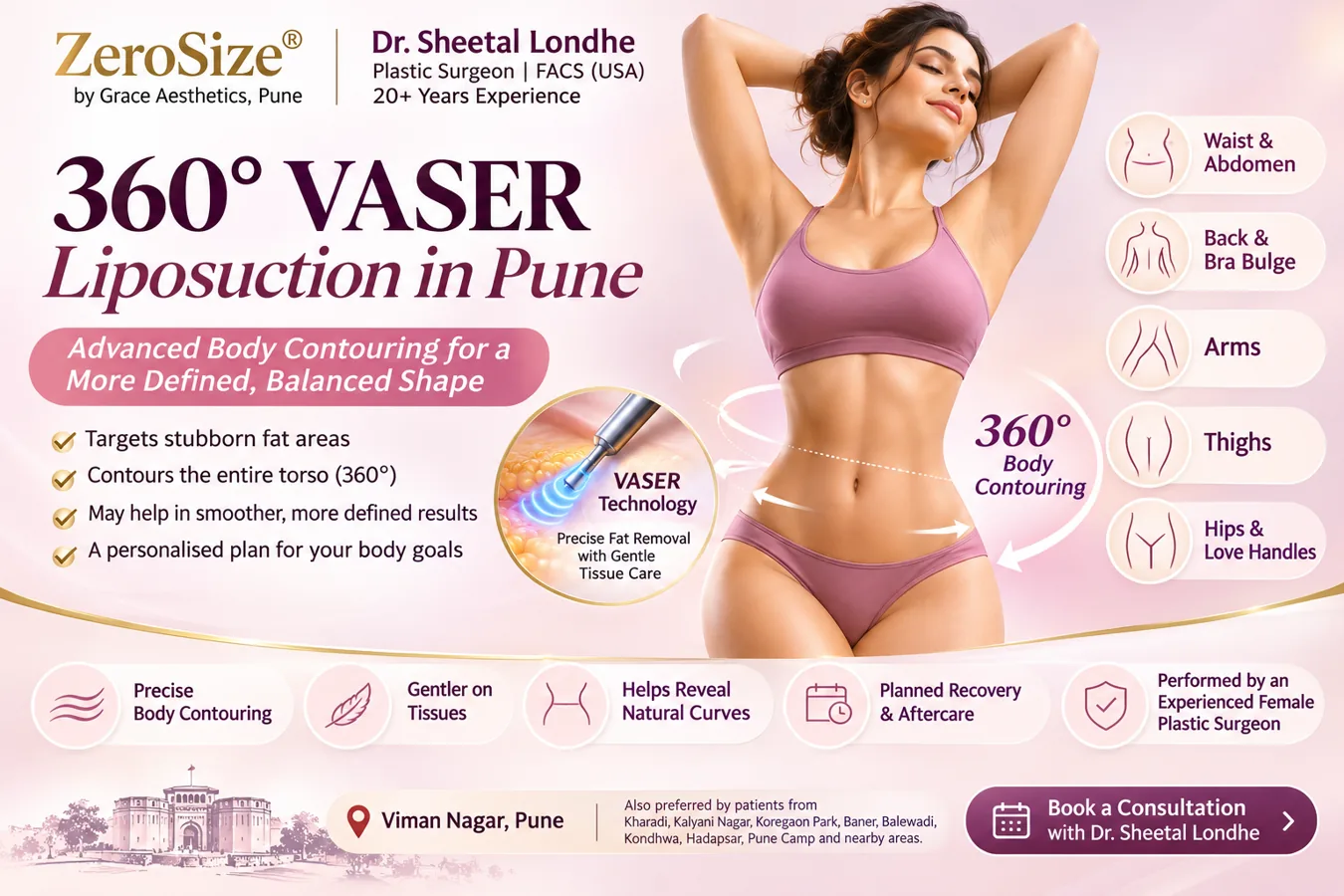
360° VASER liposuction is a form of ultrasound-assisted liposuction planned around selected areas of localised fat. It is not a weight-loss procedure, and it cannot guarantee a particular waist measurement or body shape. A consultation should distinguish fat deposits from loose skin, muscle separation and other concerns.
At ZeroSize® by Grace Aesthetics, Pune, Dr. Sheetal Londhe discusses the patient’s goals, health, anatomy, treatment alternatives and recovery needs before recommending a plan. The right choice may be VASER, another technique, a different procedure, staged treatment or no surgery.
Medically reviewed by Dr. Sheetal Londhe · Plastic Surgeon, Pune · NMC Reg. No. 2005042532 · Maharashtra Medical Council Reg. No. 2005/04/2532 · Last reviewed: 24 NOVEMBER 2026
Clinic: ZeroSize® by Grace Aesthetics, Pune
What is 360° VASER liposuction?
The term 360° describes a circumferential planning approach: rather than looking only at the front of the abdomen, the surgeon may consider the abdomen, waist, flanks and selected areas of the back together. It does not mean every patient needs treatment all the way around the body, or that every area can safely be treated during one operation.
VASER is a technology used during liposuction. Ultrasound energy helps loosen or emulsify fat before it is removed through a cannula. The surgeon still makes the essential decisions: which areas should be treated, how much contour change is appropriate, how to protect surrounding structures, and whether another procedure would address the concern more effectively. Technology does not replace surgical judgement, careful patient selection or safe operative planning.
For women considering liposuction in Pune, the first step is to identify the concern accurately. A localised fat deposit, loose skin, abdominal muscle separation, cellulite and general weight concerns are different issues. They may need different approaches. VASER can be useful for selected fat deposits, but it does not remove a large amount of excess skin, repair separated abdominal muscles or treat obesity.
How does VASER-assisted liposuction work?
The technique varies with the patient, treatment area, equipment, anaesthesia plan and surgeon’s judgement. The surgeon first marks the planned areas while the patient is standing. After the anaesthesia plan is implemented, small access incisions are made and a tumescent solution is introduced to prepare the tissue. A specialised probe is passed through the access incision and ultrasound energy helps loosen or emulsify fat in the planned tissue plane. A cannula connected to suction is then used to remove the treated fat.
The surgeon assesses the contour from more than one angle and aims to preserve smooth transitions between treated and untreated areas. Removing too much fat can create depressions, asymmetry or irregularities. A larger volume is not automatically a better result. Small incisions are dressed and the patient is monitored as the anaesthesia wears off. A compression garment may be recommended based on the areas treated and the surgeon’s protocol. The team provides instructions about wound care, movement, bathing, medicines, warning signs and follow-up.
VASER is one method of performing liposuction; it is not a guarantee of less pain, no scars, faster recovery or superior results for every person. Ask your surgeon why the technique is being recommended for your anatomy and what alternatives may offer a better balance of benefit and risk.
Procedure options: areas that may be assessed
The reference design groups procedure options into soft-lilac cards. This layout keeps that approachable visual idea, while separating core torso areas from procedures that are not interchangeable with 360° torso liposuction. These cards are starting points for discussion—not a promise that every area can be treated or combined in one session.
Abdomen
Assessment of upper and lower abdominal fat, skin elasticity and abdominal wall shape. Loose skin or muscle separation may need a different plan.
Explore abdominal liposuctionWaist & flanks
The side waist and love-handle region may be considered as part of a balanced torso contour.
Explore waist and love handlesBack & bra line
Selected back deposits may be assessed alongside the waist to plan smooth transitions beneath clothing.
Explore treatment areasThighs
Inner or outer thigh contouring requires careful assessment of skin quality, symmetry and surface irregularity risk.
Read about treatment areasUpper arms
Arm contouring may be considered for localised fat when skin recoil is adequate.
View the liposuction serviceHips & outer thighs
These areas are assessed in relation to the waist, buttock shape and overall proportions.
Explore body areasOther procedures sometimes shown alongside liposuction—such as buccal fat removal, double-chin treatment or lipoma removal—are distinct procedures with different indications, anatomy, risks and consent requirements. They should have their own dedicated explanations and should not be described as routine parts of 360° torso liposuction. Buttock contouring and fat transfer also require separate planning and discussion of their own safety considerations.
Who may be a suitable candidate?
There is no single weight, age or body measurement that automatically makes someone suitable for VASER. A good candidate is generally a person in stable health who has specific areas of localised fat, understands that liposuction is body contouring rather than weight-loss surgery, and has expectations that fit what the procedure can realistically change. The decision is made after an examination and review of medical history.
Patients often consider liposuction after maintaining a relatively stable weight and finding that certain localised deposits remain despite sustainable lifestyle habits. Weight stability helps the surgeon assess the shape that is likely to remain after healing. If weight is changing substantially, a clinician may recommend addressing that first and reassessing later. Liposuction is not a substitute for medical care for obesity or metabolic conditions.
Skin elasticity influences how the skin may adapt after fat is removed. Some patients have enough recoil for a contouring procedure; others have stretched or loose skin that may remain after liposuction. A person with substantial skin excess after pregnancy or major weight loss may need an abdominoplasty or another skin-removal procedure discussed. VASER should not be presented as a replacement for a tummy tuck when skin removal or muscle repair is the main concern.
The surgeon and anaesthesia team review medical conditions, previous operations, allergies, medicines, smoking or nicotine use, history of blood clots, bleeding concerns and any factors that may affect healing. Blood tests or other investigations may be requested. Some conditions may require optimisation, additional specialist input, postponement or a decision not to proceed. Do not stop prescribed medicines without instructions from the treating clinician.
For women who have recently been pregnant, timing should take account of recovery from childbirth, breastfeeding, stable weight, childcare support and future pregnancy plans. A future pregnancy can change abdominal contour and may affect the durability of the result. The appropriate waiting period is individual and should be discussed with the surgeon rather than assumed from a generic online rule.
It is important to understand likely benefits and limitations, possible scars, recovery restrictions, risks, the possibility of revision, and the financial and practical commitments involved. You should feel able to ask questions and take time before consenting. Read who is eligible for VASER liposuction in Pune.
When may VASER not be the right procedure?
VASER may not address the main concern when there is significant loose skin, marked abdominal muscle separation, a hernia, cellulite, stretch marks, general weight concerns or a medical condition that makes elective surgery unsafe. It may also be inappropriate when a patient expects a specific number on the weighing scale or a guaranteed waist size. The surgeon may recommend a different procedure, non-operative support, further medical assessment, postponement or no operation.
Patients with active infection, uncontrolled medical conditions, significant anaesthesia risks, untreated clotting concerns or other health issues may need treatment or specialist clearance before elective surgery can be considered. Smoking and nicotine exposure can impair healing and increase complications; the clinical team should give clear advice about stopping and the time required before and after surgery. Be honest about medicines, supplements and nicotine use. This information protects your safety.
It is also reasonable for a surgeon to decline or defer surgery if the anticipated benefit is small compared with the risks, if the treatment plan is too extensive for one session, or if the patient is not ready for the recovery process. A responsible consultation includes the possibility that surgery is not recommended. You should never feel pressured to proceed because you have enquired, attended a consultation or paid for an appointment.
VASER liposuction after pregnancy
Pregnancy can change fat distribution, skin elasticity, abdominal wall structure and breast shape. Some women notice localised fat around the abdomen, waist or back after their weight has stabilised. Others have loose skin, muscle separation or a combination of concerns. These differences matter because liposuction treats selected fat deposits; it does not remove a lower abdominal skin apron or repair separated abdominal muscles.
A post-pregnancy consultation should explore whether breastfeeding has ended, whether weight is stable, whether another pregnancy is planned, whether there is abdominal muscle separation, and how much skin laxity is present. The surgeon may examine the abdominal wall and ask about back discomfort, core weakness or a bulge that could suggest a hernia or diastasis. If a tummy tuck is being considered, the discussion should include the scar, recovery, potential muscle repair and the additional demands of the operation.
Some women explore liposuction as one component of a broader Mommy Makeover in Pune. A Mommy Makeover is not a fixed package. It may include selected abdominal or breast procedures depending on anatomy and health, but the combination and timing must be individualised. More procedures in one operation can increase complexity and recovery demands. The safest plan may involve staging procedures or choosing only the treatment that addresses the most important concern.
For more detail, see the Mommy Makeover patient journey and the guide to lipoabdominoplasty in Pune.
Consultation at ZeroSize® by Grace Aesthetics
A useful consultation is a two-way clinical conversation. You should be able to describe what bothers you, what you hope to change and what you are not willing to compromise. You do not need to use medical terminology or arrive with a procedure already selected. Bring a list of medicines and supplements, details of previous operations, relevant medical reports and questions about time away from work or caregiving.
The surgeon asks which areas concern you most, how long you have noticed them, whether your weight has changed, and whether pregnancy, surgery or a medical condition has affected the area. Your preferences about clothing, activity and recovery are part of the discussion. It is helpful to distinguish between a concern about a localised fat deposit and a concern about loose skin, abdominal bulging or overall weight.
The examination may include assessment of skin elasticity, fat distribution, asymmetry, scars, abdominal wall and general body proportions. The surgeon explains which areas may be considered and which areas should be left alone. Photographs may be taken with your consent for planning and documentation. Ask whether the proposed plan treats the front, sides and back, and how the surgeon will maintain smooth transitions.
You should hear about alternatives such as conventional liposuction, a tummy tuck, staged surgery, non-operative weight management where appropriate, or choosing not to have surgery. The surgeon should explain what VASER cannot correct. Ask what result is realistic for your skin and anatomy, what may remain after surgery, and what could require another procedure. A consultation should not rely on dramatic promises or a single before-and-after photograph.
Before booking surgery, request a written outline of the proposed procedure, areas, anaesthesia, facility, expected recovery support, follow-up schedule, fees and what is included. Ask who will be available if you have a concern after discharge. Confirm the emergency contact process. You should receive time to review consent documents and ask additional questions before making a final decision.
Preparing for surgery
Preparation is individual and should follow the instructions from your surgeon and anaesthesia team. You may be asked to complete blood tests or other investigations, attend a pre-anaesthesia review, adjust selected medicines under medical direction and avoid smoking or nicotine for a specified period. Do not independently stop blood thinners, diabetes medicines, thyroid medicines or any other prescribed treatment. Tell the team about vitamins, herbal products and over-the-counter medicines as well.
Plan practical support before the operation. Arrange transport home and an adult who can assist you during the initial period if advised. Prepare comfortable clothing that is easy to put on, a clean resting area, prescribed medicines and supplies recommended by the clinic. If you have children or caregiving responsibilities, organise help for lifting, school runs and household tasks. Recovery is easier when you do not have to manage every responsibility alone.
Follow fasting instructions exactly. The anaesthesia team will tell you when to stop food and liquids and what medicines, if any, to take on the morning of surgery. If you develop fever, cough, skin infection, new illness or another medical change before the planned date, contact the clinic rather than concealing it. The procedure may need to be postponed for safety. Do not use unverified online checklists as a substitute for the clinic’s instructions.
What happens on the day of surgery?
The team confirms your identity, consent, planned areas and relevant medical details. The surgeon may mark the treatment areas while you are standing. The anaesthesia plan is reviewed and the procedure is performed in an appropriately equipped setting. Duration depends on the number and extent of areas, the technique and whether another procedure is being performed. A fixed duration should not be promised before the surgical plan is finalised.
After surgery, you are observed while recovering from anaesthesia. The team checks your comfort, observations, dressings and mobility according to the care pathway. Some patients may go home the same day, while others may need a longer period of observation depending on the operation, health and facility protocol. Discharge should occur only when the clinical team considers it appropriate and the home-support plan is clear.
Before leaving, make sure you understand the medication schedule, garment instructions, wound care, bathing guidance, activity restrictions, follow-up date and contact details. Know which symptoms are expected and which require urgent attention. If you are unsure about a symptom, contact the treating team promptly rather than relying on social media or waiting for the next appointment.
Recovery after VASER liposuction
Recovery varies with the areas treated, extent of surgery, anaesthesia plan, individual healing and whether procedures are combined. Swelling, bruising, tenderness, temporary numbness and fluid leakage from small access sites may occur. These changes do not resolve on the same timetable for every patient. Your surgeon should provide a personalised recovery plan and explain when you can return to work, driving, exercise and lifting.
During the first few days, rest, take prescribed medicines as directed and follow garment and wound-care instructions. Gentle movement may be encouraged to support circulation, but avoid strenuous activity and follow the team’s specific advice. Do not adjust dressings or use massage devices unless instructed. Arrange help with household work, childcare and shopping. Contact the clinic if pain is worsening rather than improving or if you are worried about a new symptom.
During the first one to two weeks, some people gradually resume light daily tasks, while others need more time. Bruising and swelling may still be visible. Avoid judging the final contour at this stage. Follow the advice about returning to desk work, driving and normal routines. Do not resume exercise, heavy lifting or vigorous activity until the surgeon clears you. If your job involves physical work, discuss a realistic return-to-work plan before surgery.
Over the following weeks, swelling usually changes gradually, and treated areas may feel firm, tight or uneven while healing progresses. Compression garment use and duration depend on the surgeon’s instructions. Attend follow-up visits even when you feel well; they allow the team to assess healing and answer questions. Massage or lymphatic drainage should only be undertaken if the treating surgeon recommends it and explains when and how it should be done.
Several months after surgery, contour changes continue as swelling settles and tissues soften. The time at which a result can be fairly assessed differs between patients and areas. Weight changes, pregnancy, ageing and normal skin behaviour can affect long-term appearance. Maintain a stable lifestyle and attend follow-up appointments. Read the detailed VASER liposuction recovery guide for Pune.
Risks, side effects and safety
All surgery has risks. Liposuction may cause bruising, swelling, pain, temporary or persistent numbness, fluid collections, infection, bleeding, delayed healing, visible scars, skin irregularity, asymmetry, changes in skin sensation or dissatisfaction with the contour. Some complications may require additional treatment or another operation. The likelihood and seriousness of risks depend on the patient, treatment extent, technique, facility and clinical circumstances.
Less common but serious complications can include blood clots, pulmonary embolism, fluid shifts, anaesthesia-related complications, injury to deeper structures and other events that require urgent medical care. The risk profile should be discussed in the context of your health and the planned operation. Ask what measures are used to reduce risk, how the team monitors you, and what happens if a complication develops.
VASER uses ultrasound energy, so the surgeon must use the equipment appropriately and monitor tissue response. Thermal injury is a recognised potential concern with energy-based surgical devices. The procedure should be performed by a suitably trained surgeon in an appropriate clinical setting with a qualified anaesthesia team and a clear plan for post-operative monitoring.
Seek urgent medical assessment if you experience shortness of breath, chest pain, fainting, sudden severe weakness, heavy bleeding, rapidly increasing swelling, severe or escalating pain, high fever, spreading redness, confusion or another symptom that feels serious. Do not wait for a routine follow-up or an online response. Follow the emergency instructions supplied by your treating team and use local emergency services when needed.
VASER liposuction versus tummy tuck
Liposuction removes selected fat deposits. A tummy tuck (abdominoplasty) removes excess abdominal skin and may include tightening or repair of separated abdominal muscles when indicated. These procedures address different anatomical concerns. If your main issue is a hanging fold of skin, marked laxity or abdominal muscle separation after pregnancy, liposuction alone may not address the concern.
Some patients are assessed for a combination of liposuction and abdominoplasty, sometimes described as lipoabdominoplasty. This is a more involved plan and is not suitable for every patient. It requires assessment of skin blood supply, operative extent, health, recovery needs and complication risk. Explore the tummy tuck complete guide, mini vs full tummy tuck comparison and lipoabdominoplasty guide.
Cost of 360° VASER liposuction in Pune
The cost of VASER liposuction in Pune cannot be determined accurately from the procedure name alone. The estimate depends on the areas included, complexity and duration of surgery, anaesthesia plan, hospital or operating facility, investigations, medicines, compression garments, post-operative reviews and whether another procedure is combined. Previous surgery or additional medical needs may also affect planning.
A responsible estimate should be provided after clinical assessment and should explain what is included and excluded. Ask whether the quotation covers the surgeon’s fee, anaesthesia, operating-room and facility charges, garments, investigations, medicines, follow-up and any additional care that may be required. Clarify how changes to the operative plan would affect the estimate. Do not compare two quotations unless you know that the scope and inclusions are similar.
For broader context, see the clinic’s cosmetic surgery cost guide for Pune and the dedicated VASER liposuction cost article. Online figures are indicative information only, not a personal quotation. The final plan and estimate should follow an examination and discussion with the clinic.
Why consider ZeroSize® by Grace Aesthetics?
Choosing a surgeon is an important decision. Patients should look for appropriate specialist training, experience relevant to the procedure, clear communication, a suitable operating facility, an anaesthesia team, transparent consent and a reliable follow-up pathway. A clinic’s website or technology list cannot replace checking the surgeon’s qualifications and discussing who will personally perform each part of the operation.
ZeroSize® by Grace Aesthetics is a female-focused plastic surgery practice in Viman Nagar, Pune. Dr. Sheetal Londhe is a plastic surgeon with DNB training in Plastic Surgery and Fellowship of the American College of Surgeons (FACS, USA). Her consultation approach is intended to give women space to discuss concerns about pregnancy-related changes, body proportions, clothing fit, recovery and privacy in a respectful setting.
The clinic is located at B205, Town Square Shopping Center, 2nd Floor, above Dorabjee’s, Viman Nagar, Pune, Maharashtra, India 411014. Patients may travel from Kalyani Nagar, Koregaon Park, Kharadi, Hadapsar, Pune Camp, Baner, Balewadi, Kothrud, Pimpri-Chinchwad and other parts of Pune. Travel convenience is useful, but the quality of assessment, surgical planning and follow-up should remain the deciding factors.
Questions to ask before choosing surgery
Ask what the main anatomical concern is: localised fat, loose skin, muscle separation or a combination. Ask why VASER is being recommended rather than another approach for your body and treatment areas. Clarify which exact areas are included in the proposed 360° plan, which are excluded, and whether the surgeon recommends treating all areas in one session or staging them.
Ask what changes are realistic for your skin quality and anatomy, what will remain unchanged, and whether a tummy tuck or another procedure would address your concern more appropriately. Ask who will perform the surgery and provide anaesthesia, where it will take place, what the important risks are in your individual case and how those risks are managed.
Discuss how long you should plan away from work, exercise, driving and lifting. Ask what garment, wound care and follow-up schedule you will need. Confirm who to contact after hours if you are worried about a symptom. Request a written estimate that explains inclusions, exclusions and possible additional costs. Finally, ask what the alternatives are if you decide not to have surgery now. You should have enough information and time to make a voluntary decision.
Frequently asked questions
Is 360° VASER liposuction a weight-loss procedure?
No. Liposuction is intended to remove selected localised fat deposits and improve contour in appropriately selected patients. It is not a treatment for obesity, does not replace weight management and should not be chosen to achieve a target number on the weighing scale.
Does 360° mean the whole body is treated?
No. In this context, 360° generally refers to considering the torso from the front, sides and back. The exact areas depend on anatomy, health, treatment goals and safe operative limits. Some patients need only a few areas, while others may be advised to stage treatment.
Can VASER tighten loose skin?
Some patients may notice skin adaptation after fat removal, but VASER does not remove significant excess skin and cannot guarantee tightening. If skin laxity is the main concern, a tummy tuck or another procedure may need to be discussed.
Can VASER repair diastasis recti?
No. Liposuction removes fat and does not repair separated abdominal muscles. Diastasis recti requires a separate assessment. If muscle repair and skin removal are indicated, abdominoplasty may be discussed.
Is VASER safer than traditional liposuction?
There is no technique that is automatically safest for every patient. Safety depends on patient selection, planned areas and volume, surgeon experience, anaesthesia, facility standards and aftercare. Ask your surgeon to explain the specific advantages and risks of each option for your case.
Will I have scars?
Liposuction uses small access incisions, so scars are usually small, but they are not absent. Their location, appearance and healing vary. Ask where incisions are likely to be placed and how scar care is managed.
How long does recovery take?
Recovery depends on the extent of treatment and individual healing. Swelling, bruising, tenderness and temporary changes in sensation may continue for weeks or longer. Your surgeon will give a personalised return-to-work and activity plan. Do not use a generic timeline as clearance to exercise or lift.
When will I see the final result?
Early changes may be visible before swelling has settled. The contour continues to evolve during healing, and the point at which it can be assessed fairly varies. Your surgeon will explain the expected review timeline and what changes should prompt a call to the clinic.
Can I undergo VASER after pregnancy?
Some women may be suitable after childbirth once recovery, breastfeeding, weight stability and future pregnancy plans have been considered. Timing is individual. A consultation should also check for loose skin, abdominal muscle separation and other changes that liposuction alone may not correct.
Can VASER be combined with a tummy tuck?
It may be considered in selected patients, but combination surgery is not automatically appropriate. The surgeon must assess skin, abdominal wall, operative extent, health and recovery demands. Sometimes a staged plan is more suitable.
Can fat removed during VASER be transferred elsewhere?
Fat grafting is a separate surgical decision with its own processing, technique, indications and risks. Not all removed fat is suitable for transfer, and a transfer procedure should never be assumed to be included in a liposuction plan. Discuss the specific procedure and safety considerations with the surgeon.
Will the fat come back?
Fat cells removed from a treated area are removed, but remaining fat cells can enlarge with weight gain. Liposuction does not prevent future weight changes. A stable weight supports maintenance, but individual results can change over time.
How much does VASER liposuction cost in Pune?
The estimate depends on treatment areas, complexity, anaesthesia, facility charges, garments, investigations, medicines and follow-up. A personalised written quotation should be provided after assessment. See the clinic’s VASER cost guide for a discussion of the factors involved.
Where is ZeroSize® located?
ZeroSize® by Grace Aesthetics is in Viman Nagar, Pune, Maharashtra, India. Patients can contact the clinic to arrange a private consultation and confirm appointment details before travelling.
Explore the VASER and liposuction learning centre
This service page is the main patient-facing overview for 360° VASER liposuction for women. The supporting articles below answer narrower questions in greater depth. They should complement this page rather than compete with it for the same broad service intent.
- Liposuction in Pune – main liposuction service page
- Liposuction in Pune: complete guide to procedure, suitability, recovery and risks
- 360° VASER liposuction in Pune: complete guide to body contouring
- 360° VASER before and after: results, recovery, risks and cost
- VASER treatment areas: abdomen, waist and thighs
- VASER liposuction eligibility and health considerations
- VASER liposuction recovery and aftercare
- VASER liposuction cost in Pune
- Abdominal liposuction in Pune
- Waist and love-handle liposuction in Pune
- VASER liposuction vs tummy tuck
A considered next step
A consultation is an opportunity to understand your anatomy and options—not a commitment to surgery. If you are considering 360° VASER liposuction in Pune, speak with the clinical team about your goals, health, recovery needs and alternatives.
ZeroSize® by Grace Aesthetics · Viman Nagar, Pune, Maharashtra, India. Individual assessment is essential. No specific outcome is guaranteed.
Medical information on this page is general education and does not replace an in-person consultation, diagnosis or individual treatment advice. The final decision about surgery should follow assessment by a qualified plastic surgeon and anaesthesia team.
Clinical references and further reading
This patient guide is intended to support an informed consultation, not replace individual medical advice. For independent information about ultrasound-assisted liposuction, patient selection and potential complications, readers may consult the following professional resources:
- American Society of Plastic Surgeons: assisted liposuction candidates — explains patient selection and notes that evidence does not establish better end results for assisted techniques in every case.
- American Society of Plastic Surgeons: how assisted liposuction works — outlines the general principles of ultrasound-assisted fat removal.
- American Society of Plastic Surgeons: liposuction risks and safety — summarises potential complications, including contour irregularity, infection, blood clots and thermal injury with ultrasound-assisted techniques.
These resources describe general patient information. Your surgeon should explain how the evidence and risks apply to your medical history, proposed treatment areas and operative plan.